Self-Employed? Here's How to Get Approved for Car or Business Finance
April 17, 2026
Getting approved for car or business finance when you’re self-employed is absolutely achievable, but it requires a different approach than a standard PAYG application. Lenders assess self-employed applicants based on income consistency, business stability, and documentation quality rather than simple payslips.
According to the Australian Bureau of Statistics, over 2 million Australians are self-employed, representing roughly 16% of the total workforce. Yet many sole traders, contractors, and business owners believe financing is out of reach because their income fluctuates or their tax returns show lower net figures. The reality is that dozens of lenders actively welcome self-employed borrowers, and a finance broker with access to a broad lender panel can match you with the right one.
This article breaks down exactly what self-employed applicants need to know about qualifying for car finance or business finance, from documentation requirements to approval strategies that actually work.
Key Takeaways
- Self-employed borrowers can access the same competitive rates as PAYG applicants with the right preparation and lender match.
- Documentation is the single biggest factor in approval. Organised financials dramatically improve your chances.
- A finance broker with access to 40+ lenders can identify options specifically designed for ABN holders and sole traders.
- Trading history, BAS statements, and bank statements often matter more than tax returns alone.
- Structuring your application correctly from the start avoids unnecessary credit enquiries that can hurt your credit score.
Find The Best Deal

With over 10 years of industry experience we are a leading independent broker with a diverse panel of 40 + lenders to find you the best solution, tailored to you and your goals!
Overview
This guide covers why self-employed applications differ from PAYG, the exact documents lenders want to see, strategies to strengthen your application, common mistakes to avoid, and how working with a specialist broker simplifies the entire process. Whether you need a vehicle for personal use or a fleet of assets for your growing business, the path to approval starts with understanding what lenders actually look for.
Why Self-Employed Finance Applications Are Different
Income Verification Is More Complex
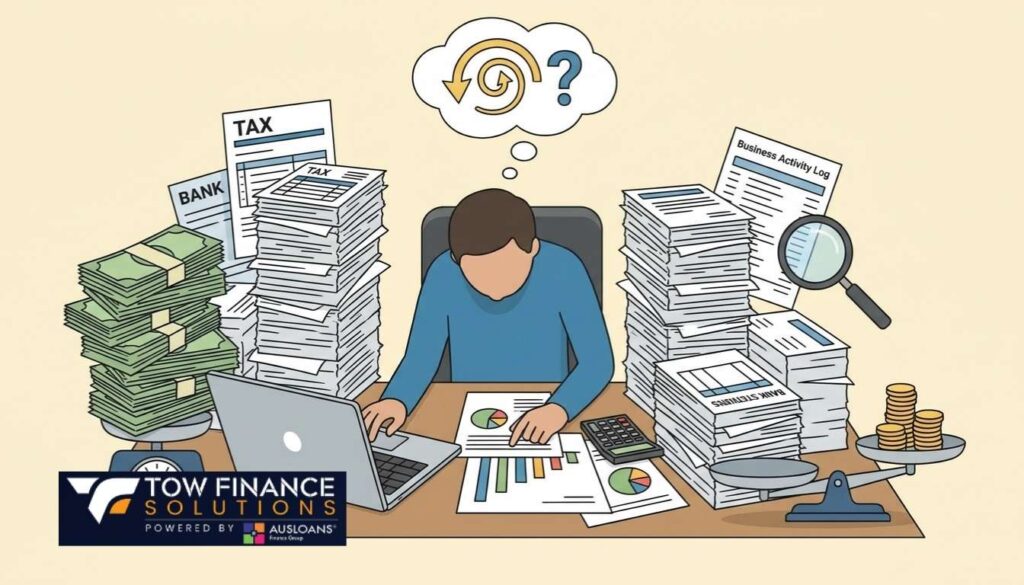
PAYG employees hand over two payslips and a group certificate. Self-employed applicants don’t have that luxury. Lenders need to verify that your income is real, consistent, and sufficient to cover repayments.
The Australian Taxation Office reports that small businesses account for 97% of all Australian businesses. Lenders know this market is enormous, but they also know self-employed income can vary month to month. That variability is what makes documentation so critical.
Most lenders look at a combination of business activity statements (BAS), tax returns, bank statements, and accountant declarations. The specific mix depends on the lender and how long you’ve been trading. Some lenders accept as little as 6 months of BAS statements, while others require two full years of tax returns.
Tax Minimisation Creates a Catch-22
Here’s the tension every self-employed borrower faces: your accountant works hard to minimise your taxable income, but lenders assess your borrowing capacity based on that same taxable income. A business earning $180,000 in revenue might show $65,000 in net profit after deductions, and lenders base their calculations on that lower figure.
This doesn’t mean you’re stuck. Many lenders use “add-back” calculations, where they add depreciation, one-off expenses, or other non-cash deductions back into your income figure to get a more realistic picture of your actual earning capacity. The key is working with a broker who knows which lenders offer these add-back policies.
What Documents Do You Need?
Having the right paperwork ready before you apply is the fastest way to streamline your approval. According to the Australian Securities and Investments Commission (ASIC), responsible lending obligations require lenders to verify income through documented evidence, not verbal declarations.
For Self-Employed Applicants Trading Over 2 Years
- Last two years of personal and business tax returns
- Most recent Notice of Assessment from the ATO
- Last 6-12 months of business bank statements
- Current BAS statements (typically last 4 quarters)
- ABN registration confirmation
- Valid driver’s licence and proof of address
For Self-Employed Applicants Trading Under 2 Years
- Last 6-12 months of BAS statements
- Business bank statements showing consistent revenue
- Accountant’s letter or declaration confirming income
- ABN registration details and GST registration (if applicable)
- Evidence of industry experience or prior employment in the same field
Low-Doc and No-Doc Options
Some lenders offer low-documentation loans for self-employed borrowers who can’t provide full financials. These typically require a signed income declaration, 3-6 months of bank statements, and a valid ABN registered for at least 12 months. Interest rates on low-doc products are generally 0.5% to 2% higher than full-doc equivalents, but they provide a genuine pathway when traditional documentation isn’t available.
Understanding the difference between pre-qualification and pre-approval can also help you gauge where you stand before committing to a full application.
How to Strengthen Your Application Before You Apply
1. Get Your Financials in Order Early
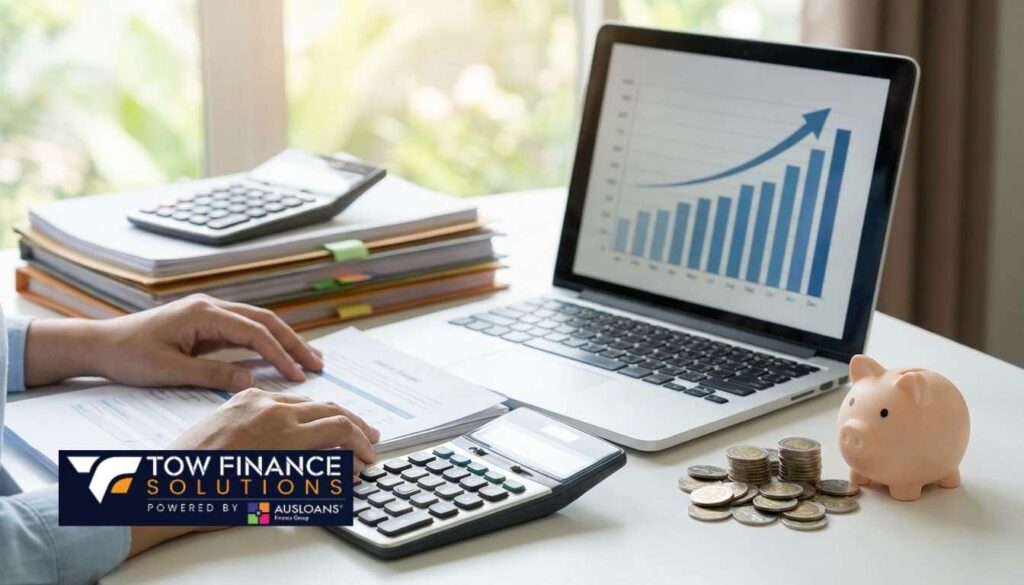
Don’t wait until you need finance to organise your books. Lenders want clean, consistent records. Ensure your BAS is lodged on time, your bank statements show regular deposits, and your accountant has current figures ready.
According to the Council of Small Business Organisations of Australia, businesses with up-to-date financial records are significantly more likely to secure financing on favourable terms. Preparation is the single highest-impact step you can take.
2. Separate Personal and Business Banking
Lenders scrutinise bank statements closely. Mixing personal and business transactions makes it harder to verify business income and raises red flags. If you haven’t already, open a dedicated business account and run all business revenue and expenses through it.
3. Manage Your Credit Profile
Every finance application triggers a credit enquiry. Multiple enquiries in a short period signal desperation to lenders and can lower your credit score. This is exactly why working with a broker matters: they submit one application to the right lender rather than letting you shotgun applications across multiple providers.
Learn more about protecting your score in our guide on how to boost your loan approval odds.
4. Reduce Existing Debt Where Possible
Lenders calculate your debt-to-income ratio to determine repayment capacity. Paying down credit cards, personal loans, or unused credit facilities before applying can meaningfully improve your borrowing power. Even closing a credit card you don’t use removes its limit from your liabilities.
5. Save a Larger Deposit
A deposit of 10-20% reduces the lender’s risk and often unlocks better interest rates. For business vehicle financing, a deposit can also reduce your monthly repayments and improve cash flow, which is especially valuable for seasonal businesses.
Car Finance Options for Self-Employed Borrowers
Self-employed Australians have access to several car finance structures, each with different benefits depending on whether the vehicle is for personal or business use.
Chattel Mortgage
A chattel mortgage is one of the most popular options for self-employed borrowers purchasing a vehicle for business use. You own the vehicle from day one, the interest and depreciation are tax-deductible, and you can claim the GST on the purchase price upfront. This structure works well for sole traders and companies registered for GST.
Consumer Car Loan (Secured)
For personal vehicle purchases, a secured car loan uses the vehicle as collateral, which typically results in lower interest rates compared to unsecured options. Approval depends on your income documentation and credit history rather than the purpose of the vehicle.
Lease Arrangements
Operating leases and finance leases suit self-employed borrowers who prefer lower monthly payments or want to upgrade vehicles regularly. Lease payments are generally tax-deductible as a business expense, though the tax treatment differs from a chattel mortgage. Your accountant can advise on which structure provides the best outcome for your specific situation.
Understanding how balloon payments work is also important, as many self-employed borrowers use balloon structures to keep repayments manageable during the loan term.
Business Finance Options for Self-Employed Borrowers
Beyond vehicle finance, self-employed operators often need funding for equipment, cash flow, or business growth. The right product depends on what you need the funds for and how quickly you need them.
Equipment and Asset Finance
Purpose-built for purchasing business assets like machinery, tools, technology, or vehicles. The asset itself secures the loan, which means approval criteria can be more flexible than unsecured lending. Lenders focus heavily on the asset’s value and your ability to service the repayment.
Business Line of Credit
A business line of credit provides a revolving credit facility you draw on as needed. This is ideal for managing irregular cash flow, covering short-term gaps, or funding opportunities as they arise. You only pay interest on what you use.
Short-Term and Medium-Term Business Loans
For specific projects or purchases, a term loan provides a lump sum with fixed repayments over a set period. Businesses dealing with seasonal cash flow challenges may find flexible repayment structures particularly useful.
Why a Finance Broker Makes the Difference
Applying directly to a bank as a self-employed borrower often leads to frustration. Banks have rigid criteria, and if your application doesn’t fit their box, you get declined, which leaves a mark on your credit file.
A specialist finance broker like Tow Finance Solutions works differently. With access to over 40 lenders, a broker assesses your situation first, identifies lenders whose criteria match your profile, and submits your application where it’s most likely to succeed.
“Self-employed borrowers often have stronger financial positions than their tax returns suggest,” says a senior lending consultant. “The broker’s job is to present the full picture to the right lender, not force a square peg into a round hole.”
Tow Finance Solutions offers approvals in as little as one hour, with a process designed to protect your credit score by minimising unnecessary enquiries. The online application takes minutes, and a dedicated consultant guides you through every step.

Common Mistakes Self-Employed Borrowers Make
Applying to multiple lenders simultaneously. Each application creates a credit enquiry. Three or four enquiries in a week can drop your score and make subsequent applications harder. Always use a broker to target the right lender first.

Not lodging BAS on time. Late or missing BAS lodgements signal poor financial management to lenders. The ATO’s lodgement program sets clear deadlines, and lenders check compliance as part of their assessment.
Underestimating the importance of bank statements. Lenders review your transaction history for gambling activity, dishonour fees, and overall spending behaviour. Clean bank statements with consistent deposits are one of the strongest indicators of reliability.
Failing to disclose all liabilities. Lenders conduct credit checks and cross-reference your declarations. Undisclosed debts, including buy-now-pay-later accounts, create trust issues that can derail an otherwise strong application.
Avoid these and other critical errors outlined in our guide to the top mistakes to avoid when applying for a loan.
Frequently Asked Questions
Can I get car finance with only 6 months of ABN history? Yes. Several lenders accept applicants with as little as 6 months of ABN registration, provided you can supply BAS statements and bank statements showing consistent income. A broker can match you with these specific lenders quickly.
Do self-employed borrowers pay higher interest rates? Not necessarily. With full documentation and a strong credit profile, self-employed applicants can access the same competitive rates as PAYG borrowers. Low-doc applications typically carry a small premium of 0.5% to 2%.
What if my tax returns show low income due to deductions? Many lenders use add-back policies that account for depreciation, one-off expenses, and other non-cash deductions. Your broker presents your income in the most favourable, accurate light by matching you with lenders who apply these calculations.
Can I finance a vehicle for both personal and business use? Yes. The finance structure you choose (chattel mortgage, consumer loan, or lease) will depend on the primary use and your tax situation. Your accountant and broker can work together to find the best fit.
How long does approval take for self-employed applicants? With Tow Finance Solutions, approvals can happen in as little as 1 hour when documentation is complete. Complex applications involving low-doc products may take 24-48 hours. Learn more about car finance approval timelines.
Do I need a guarantor as a self-employed borrower? Not usually. Most self-employed applications are assessed on your own income and credit history. However, a guarantor can strengthen a borderline application or help you access better rates.
Will applying for finance affect my credit score? Every formal application creates a credit enquiry, but working with a broker minimises this risk. Tow Finance Solutions’ process is designed for credit score protection, submitting applications strategically rather than broadly.
What’s the difference between a chattel mortgage and a car loan? A chattel mortgage is a business finance product where you own the vehicle and claim tax deductions on interest and depreciation. A standard car loan is a consumer product without those business tax benefits. Your choice depends on the vehicle’s use.
Can I get finance if I have a default on my credit file? Yes, though options may be more limited. Some lenders within Tow Finance Solutions’ panel specialise in credit-impaired applicants. Being upfront about defaults and demonstrating improved financial behaviour strengthens your case.
What’s the minimum deposit required? Some lenders offer 100% financing with no deposit for strong applicants. However, a 10-20% deposit improves your approval odds, reduces your repayment amount, and may unlock lower interest rates.
Take the Next Step
Self-employed Australians deserve the same access to competitive finance as everyone else. The difference between approval and rejection often comes down to preparation, documentation, and choosing the right lender, not your employment status.
Tow Finance Solutions specialises in finding the right fit from a panel of 40+ lenders, with approvals in as little as one hour and a process built to protect your credit score. Whether you need a car, a business vehicle, or asset finance to grow your operations, the team is ready to help.
Apply online today or call (07) 4410 3375 to speak with a dedicated consultant about your self-employed finance options.
Sources
- Australian Bureau of Statistics — Labour Force, Australia: abs.gov.au
- Australian Taxation Office — Small Business Overview: ato.gov.au
- Australian Securities and Investments Commission — Responsible Lending Obligations: asic.gov.au
- Council of Small Business Organisations of Australia: cosboa.org.au