
Tow Finance Solution

Categories
Loan guide

Novated Lease Explained: How It Works and Who It’s Best For

Novated Lease Explained: How It Works and Who It's Best For

July 24, 2026

A novated lease is a three-way agreement between you, your employer, and a finance company that lets you pay for a car and its running costs from your pre-tax salary. This lowers your taxable income and can save you thousands. It works best for salaried employees on a decent income, and the savings are largest on eligible electric vehicles, which are currently exempt from Fringe Benefits Tax.

That is the short version. Below is exactly how the arrangement works, the tax rules that make it worthwhile, and how to tell whether it suits your situation.

Key Takeaways

  • A novated lease bundles your car finance and running costs into one pre-tax salary deduction.
  • The tax benefit comes from reducing your taxable income, so higher earners save more.
  • Eligible electric vehicles are exempt from Fringe Benefits Tax (FBT) until at least 31 March 2027, making them the standout choice right now.
  • Every lease ends with a residual (balloon) payment set by ATO minimum percentages.
  • It suits salaried (PAYG) employees whose employer offers salary packaging. If you are self-employed or between jobs, a competitive car loan is often the better path.

Find The Best Deal

cropped-view-of-business-partners-shaking-hands-an-SUBGQMC.jpg

With over 10 years of industry experience we are a leading independent broker with a diverse panel of 40 + lenders to find you the best solution, tailored to you and your goals!

What Is a Novated Lease?

A novated lease is a car finance arrangement built around your salary. Instead of paying for a vehicle with your after-tax pay, your employer deducts the lease and running costs from your salary before tax is calculated.

The word “novated” refers to a novation deed, the legal document that transfers your lease obligations to your employer while you work there. Three parties are involved: you (the employee), your employer, and a financier, usually coordinated by a salary packaging provider.

You choose the car, not your employer. The financier owns the vehicle during the lease term, your employer makes the payments from your pay, and you get full private use. If you leave your job, the lease travels with you, though your new employer must agree to take on the payments.

How Does a Novated Lease Work?

The mechanics are simpler than the jargon suggests. Here is the process from start to finish:

  1. Choose your car and lease term. Terms typically run one to five years. You pick the vehicle, whether new, demo, or used.
  2. Get a quote. A salary packaging provider calculates your fortnightly deduction, bundling the finance plus estimated running costs.
  3. Sign the novation deed. You, your employer, and the financier formalise the agreement.
  4. Payments come from your pay. Your employer deducts the packaged amount from your salary, splitting it between pre-tax and post-tax as needed.
  5. Running costs are bundled in. Fuel or electricity, servicing, tyres, registration, and insurance are paid from a running-costs account, so you rarely face a surprise car bill.
  6. Settle the residual at the end. You pay a final lump sum, refinance it, or trade the car in on a new lease.

The convenience is a genuine drawcard. As one salary packaging principle puts it, you never have to budget for fuel or a service again because it is all handled inside a single deduction.

The Tax Side: FBT, ECM and the Statutory Method

The tax benefit is the whole point of a novated lease, so it is worth understanding the three terms that drive it.

Fringe Benefits Tax (FBT) is a tax employers pay on non-cash benefits given to staff, including a packaged car. FBT is charged at a flat 47% on the benefit’s grossed-up taxable value, and it is assessed over the FBT year of 1 April to 31 March, not the normal income-tax year.

The statutory formula method is how most novated leases value that benefit. It sets the taxable value at a flat 20% of the car’s base value, regardless of how many kilometres you drive. This flat rate has applied to arrangements entered into since 10 May 2011. On a $40,000 car, the taxable value works out to $8,000.

The Employee Contribution Method (ECM) is what stops FBT from eating your savings. By paying part of the lease from your post-tax salary, you reduce the FBT taxable value dollar for dollar. When your post-tax contribution matches the taxable value, the FBT bill is reduced to nil. According to the ATO’s car leasing and FBT guidance, the arrangement must be a genuine “bona fide” lease to be treated this way.

There is a GST bonus too. Your employer claims the GST credit on the vehicle and running costs, so you effectively buy the car without paying GST on it, up to the ATO car limit. Combined with the income-tax saving on pre-tax deductions, this is where the real value sits.

Electric Vehicles and the FBT Exemption

The biggest reason novated leases have surged in popularity is the electric car FBT exemption. Since 1 July 2022, eligible zero and low-emissions vehicles provided through a novated lease have been fully exempt from FBT.
When a car is FBT-exempt, your entire lease payment can come from pre-tax salary with no offsetting post-tax contribution needed. That is what pushes the savings on an EV well beyond those on a petrol or diesel car. Some providers report total savings exceeding $15,000 over a lease on higher-value electric models.

To qualify, the vehicle must meet all of these conditions:

  • It is a battery electric vehicle (BEV) or hydrogen fuel cell vehicle (FCEV).
  • It was first held and used on or after 1 July 2022.
  • Its value sits below the fuel-efficient luxury car tax (LCT) threshold, which is $91,661 for 2026-27 (up from $91,387 in 2025-26).
  • LCT has never been payable on the car at any point in its history.

Two important changes are worth knowing. First, plug-in hybrids (PHEVs) stopped qualifying for new arrangements from 1 April 2025, so only full electric and hydrogen models now make the cut. Second, the government has confirmed a phased wind-back: the current rules run until 31 March 2027, then the exemption begins to taper, narrowing toward a 25% discount from 2029. Existing leases are grandfathered, meaning if you sign before a change takes effect, you generally keep the current treatment for the full term. You can read the detail in this PwC summary of the phased FBT changes.

One catch often missed: even an FBT-exempt EV lease creates a Reportable Fringe Benefits Amount (RFBA) on your income statement. It is not extra tax, but it counts toward your adjusted taxable income, which can affect HELP/HECS repayments, the Medicare levy surcharge, Division 293 tax, and means-tested payments like childcare subsidy. Factor this in before you commit.

Novated Lease vs Car Loan

A novated lease is not automatically better than a car loan. It depends on your employment, income, and vehicle choice. Here is how the two compare:

Feature

Novated Lease

Car Loan

Who can get it

Salaried (PAYG) employees with an employer scheme

Almost anyone, including self-employed

Paid from

Pre-tax salary (plus some post-tax)

After-tax income

Running costs

Bundled in (fuel, rego, insurance, servicing)

Paid separately by you

GST on the car

Employer claims it, you save it

You pay it

Tax benefit

Reduces taxable income; EVs can be FBT-exempt

None on a personal loan

Ownership

Financier owns it; you settle a residual to keep it

You own it from day one

If you change jobs

Lease transfers, or you cover payments

Unaffected

End of term

Pay or refinance the residual

Loan simply ends

For many employees, especially those choosing an EV, the lease wins. For the self-employed, casual workers, or anyone whose employer does not offer packaging, a car loan is usually simpler and cheaper. See our guide to secured versus unsecured loans to understand the alternatives.

End of Lease: Your Options

Every novated lease finishes with a residual payment, a lump sum the ATO requires so the deal counts as a genuine lease rather than a disguised purchase. The minimum residual is a set percentage of the car’s base value, scaled to the term:

Lease Term

Minimum Residual

1 year

65.63%

2 years

56.25%

3 years

46.88%

4 years

37.50%

5 years

28.13%

When the term ends, you generally have three choices. You can pay out the residual and own the car outright. You can trade it in and roll into a new lease on a fresh vehicle. Or you can sell the car, pay the residual, and keep any surplus.

If you want to keep the vehicle but do not have the lump sum on hand, you can refinance the residual into a straightforward car loan. This is a common service, and it is exactly the kind of tailored financing a broker arranges.

Who Is a Novated Lease Best For?

A novated lease rewards the right circumstances and penalises the wrong ones. It tends to suit you if:

  • You are a salaried (PAYG) employee whose employer offers salary packaging.
  • You earn enough that a higher marginal tax rate (30% or 37%) makes the pre-tax saving meaningful.
  • You want an electric vehicle and can take advantage of the FBT exemption.
  • You value bundled running costs and predictable budgeting.
  • You have stable employment.

It is usually not the best fit if:

  • You are self-employed or a sole trader with no employer to novate the lease. A business vehicle loan or chattel mortgage is generally better.
  • You are a lower-income earner, where the tax saving is smaller.
  • You change jobs frequently or expect a career break, since you cover payments during any gap.
  • You want to own a car outright as cheaply as possible and drive very few kilometres.

Because the numbers hinge on your salary, vehicle price, and lease term, this is general information rather than personal advice. Run your own figures and speak to a licensed tax or financial professional before committing.

How Tow Finance Solutions Can Help

Tow Finance Solutions is an independent finance broker with over 10 years of experience and a panel of more than 40 lenders. While a novated lease is arranged through your employer and a salary packaging provider, deciding whether to lease or simply finance a car is where expert, unbiased guidance pays off.

If a novated lease is not available to you, or the numbers do not stack up, the team can find a competitive car loan tailored to your situation, with approvals in as little as one hour. Your application is checked against more than 1,000 lender policies before it reaches a lender, which helps protect your credit score.

Tow Finance Solutions can also refinance a lease residual, arrange finance for a used EV, or structure business vehicle finance for self-employed buyers. New to borrowing? Start with our guide to the loan application process for first-time borrowers, or explore options for recreational vehicles in our leisure finance overview.

Frequently Asked Questions

How does a novated lease work in simple terms? Your employer pays for your car and its running costs directly from your salary before tax is deducted, using a three-way agreement between you, your employer, and a finance company. This lowers your taxable income. At the end of the term you pay a residual lump sum to keep the car, or trade it in.

Do you save money with a novated lease? Often yes, but it depends on your income and car choice. Savings come from paying with pre-tax salary, avoiding GST on the vehicle, and bundling running costs. Higher earners save more. Electric vehicles save the most because they are currently exempt from Fringe Benefits Tax.

What is FBT on a novated lease? Fringe Benefits Tax is charged at 47% on the grossed-up taxable value of a packaged car. Most leases use the statutory method, valuing the benefit at a flat 20% of the car’s base value. The Employee Contribution Method offsets this, and eligible EVs are exempt from FBT entirely.

Are electric cars FBT-exempt on a novated lease? Yes. Eligible battery electric and hydrogen vehicles first used on or after 1 July 2022 and priced below the fuel-efficient luxury car tax threshold ($91,661 for 2026-27) are FBT-exempt. Plug-in hybrids no longer qualify for new leases from 1 April 2025, and the exemption phases down from 2027.

What happens at the end of a novated lease? You pay the residual (balloon) value to own the car, refinance that residual into a car loan, trade the car in on a new lease, or sell it and keep any surplus after paying the residual. The residual is a fixed percentage set by ATO rules, based on your lease term.

Can I get a novated lease if I am self-employed? Generally no. A novated lease requires an employer to make the pre-tax deductions, so sole traders and self-employed people usually cannot use one. A business car loan or chattel mortgage is the standard alternative and can offer its own tax advantages.

What happens to my novated lease if I change jobs? The lease travels with you. Your new employer needs to agree to take over the salary deductions. Until that is set up, or if you are between jobs, you make the lease payments directly yourself, so stable employment makes the arrangement smoother.

Does a novated lease affect my HECS or government benefits? It can. Even an FBT-exempt EV lease produces a Reportable Fringe Benefits Amount on your income statement. This is not extra tax, but it is included in your adjusted taxable income, which can raise HELP/HECS repayments and reduce some means-tested payments.

Ready to Work Out Your Best Option?

Weighing a novated lease against a straightforward car loan? Contact us for a fast, no-pressure comparison across 40+ lenders, and get a finance solution matched to your situation. Call (07) 4410 3375 or apply online in minutes.

Disclaimer

This article is general information only and does not take into account your personal circumstances, financial situation, or needs. It is not tax, financial, or legal advice. Tax rules, thresholds, and FBT settings change and may have changed since publication. Speak to a licensed tax agent, accountant, or financial adviser, and confirm current rules with the ATO before making any decision.

Sources
our partner lenders
Categories
Loan guide

Hybrid Caravan and Camper Trailer Finance: A Complete Buyer’s Guide

Hybrid Caravan and Camper Trailer Finance: A Complete Buyer's Guide

June 25, 2026

Yes, you can finance a hybrid caravan or camper trailer in Australia, usually through a secured leisure loan over one to seven years, with no deposit required and approvals often turned around in as little as one hour. A hybrid caravan finance arrangement uses the van itself as security, which keeps interest rates lower than an unsecured personal loan. This guide explains how the finance works, what it costs in 2026, and how to get approved fast.

Hybrid caravans sit between a rugged camper trailer and a full touring caravan, and that middle ground is exactly why they have surged in popularity. Caravan and campervan registrations reached almost 938,000 in 2025, a 32% increase since 2019 and an all-time record, according to Tourism Research Australia. Financing one well comes down to choosing the right loan structure, not just the lowest advertised rate.

Overview

This guide covers what a hybrid caravan actually is, how much you should expect to pay, current finance rates and loan terms, the secured-versus-unsecured decision, what lenders assess, and how to speed up approval. It finishes with a detailed FAQ and the documents you need to apply.

Key Takeaways

  • Hybrid caravans combine camper trailer toughness with caravan comfort, typically priced between $39,000 and $97,000 new.
  • Secured loans use the van as collateral and carry lower rates than unsecured personal loans.
  • Loan terms run from one to seven years, with no deposit needed in most cases.
  • New-model loans averaged around 8.65% p.a. in 2025; used models averaged higher.
  • The average Australian caravan loan is $48,406, sitting squarely in the hybrid price bracket.
  • Pre-approval lasts 30 to 90 days and lets you shop with a firm budget.

Find The Best Deal

cropped-view-of-business-partners-shaking-hands-an-SUBGQMC.jpg

With over 10 years of industry experience we are a leading independent broker with a diverse panel of 40 + lenders to find you the best solution, tailored to you and your goals!

What Is a Hybrid Caravan or Camper Trailer?

A hybrid caravan is a compact, off-road-capable van that blends the lightweight, go-anywhere build of a camper trailer with the hard walls, fixed bed and internal amenities of a full caravan. Unlike a soft-floor camper, a hybrid has a solid roof and body, so it protects you from harsh weather while still being light enough to tow off the bitumen.

Camping Trailer and Hybrid Finance

The category matters for finance because weight and use change how a lender views the asset. A hybrid is classified as a towable recreational vehicle, the same category that captured 63.37% of the Australian recreational vehicle market in 2025.

Hybrids usually feature independent off-road suspension, a DO35-style hitch coupling (a heavy-duty articulating tow connection built for rough terrain), lithium batteries and solar for off-grid power. These inclusions add value but also add to the price, which is why understanding finance structure early pays off.

Most buyers fall into one of three groups: couples chasing remote tracks, young families wanting a flexible weekender, and grey nomads who want comfort without towing a large van. Private buyers accounted for 78.17% of the recreational vehicle market in 2025.

How Much Does a Typical Hybrid Caravan Cost in Australia?

Expect to pay between $39,000 and $97,000 for a new hybrid caravan, with most family-ready models landing in the $45,000 to $65,000 range. Budget hybrids from established brands start around $43,000, while premium tandem-axle, fully off-grid units climb toward $90,000 and beyond.

For context, the most affordable new hybrids in 2025 included models priced from the low-to-mid $40,000s, typically offering a queen bed, lithium power and an external kitchen. Used hybrids can be found from the high $30,000s, which lowers your borrowing amount but may attract a higher interest rate.

These price points sit right at the national average. The average caravan loan amount in Australia is $48,406, while campervan borrowers average $37,975, according to Money.com.au borrower data. If you are weighing whether now is the right time to buy, our guide on borrowing during inflation is worth a read.

Hybrid Type

Typical Price (New)

Common Loan Amount

Best-Suited Loan Term

Compact couples hybrid

$40,000–$50,000

$40,000–$48,000

3–5 years

Family pop-top hybrid

$48,000–$65,000

$45,000–$60,000

5–7 years

Premium off-grid hybrid

$65,000–$97,000

$60,000–$90,000

5–7 years

Hybrid Caravan Finance: Rates and Loan Terms in 2026

Secured hybrid caravan loans generally carry fixed interest rates, with terms from one to seven years and no deposit required. A fixed rate means your repayment stays the same for the full loan, making it easy to budget regardless of what the Reserve Bank does next.

Rates vary by lender, the age of the van, and your credit profile. The average interest rate for new caravan loans in 2025 was 8.65% p.a., while the average for used models rose to 11.93% p.a., according to Savvy. Across the market, caravan loan interest rates generally range from about 5.35% p.a. to 14.99% p.a., with the strongest applicants securing the lowest end.SavvyFinder

Interest rates have firmed up recently. The RBA held the cash rate at 4.35% in June 2026 after three increases earlier in the year, which has kept fixed leisure-loan rates elevated. Locking in a fixed rate now removes the uncertainty of further movement.A balloon payment can lower your monthly repayments by deferring a lump sum to the end of the term, though you pay more interest overall. If that structure interests you, see how balloon payments work before you commit, and use a loan calculator to compare scenarios.

Secured vs Unsecured: Which Loan Should You Choose?

The best choice for most buyers is a secured loan, because using the hybrid as collateral lowers the lender’s risk and your rate. Lenders typically advance up to 100% of the van’s value on a secured loan, so you can drive away without a deposit.

Camper Loan Approved

An unsecured loan offers more flexibility, since the funds are not tied to the asset and can cover extras the lender may not include under secured finance. The trade-off is cost. Unsecured rates run higher because the lender has no asset to recover if repayments stop.

Feature

Secured Loan

Unsecured Loan

Interest rate

Lower (van is collateral)

Higher

Deposit

Often none required

Often none required

Borrowing limit

Up to 100%+ of value

Generally lower

Covers accessories

Limited

More flexible

Risk if you default

Van can be repossessed

No asset taken directly

For a deeper breakdown, read our secured vs unsecured comparison. According to ASIC, lenders holding a credit licence must ensure any loan is not unsuitable for the consumer, so a reputable broker will match the structure to your situation rather than push the highest-margin product.

What Lenders Assess Before Approving Your Loan

Lenders approve hybrid caravan finance based on your income stability, existing debts, credit history, and the age and value of the van. A homeowner in full-time employment will generally receive a sharper rate than a casual worker who rents, because the application carries less perceived risk.

The van itself is also assessed. Some lenders will only finance caravans up to a certain age, for example under 10 years old at the end of the loan term, which protects their security in case of default. Older or rarer models can attract a rate loading.

Your credit score is one of the biggest levers you control. If yours needs work, our credit score guide walks through five practical steps, and the common mistakes article helps you avoid the errors that slow approvals down.

How to Get Approved Fast

The fastest path to approval is to seek pre-approval, gather your documents in advance, and apply through a broker with a wide lender panel. Tow Finance Solutions partners with more than 40 lenders and delivers approvals in as little as one hour.

Camper trailer financing approved

Pre-approval tells you exactly how much you can spend before you start negotiating with a dealer. Pre-approval typically lasts 30 to 90 days and does not lock you into a specific loan. Understanding the difference between pre-qualification and pre-approval helps you use each at the right stage. Finder

Documents you will generally need:

  1. Photo identification (driver licence or passport).
  2. Proof of income (recent payslips or, if self-employed, tax returns and bank statements).
  3. Details of the hybrid caravan (purchase price, make, model, year).
  4. A summary of existing debts and living expenses.

A secured loan can also cover registration, insurance and accessories such as solar, annexes and extra batteries, provided the total stays within the lender’s limit. Watch the fine print, because hidden fees can quietly raise your real cost.

Frequently Asked Questions

What interest rate will I pay on a hybrid caravan loan?
Secured caravan loan rates generally range from about 5.35% to 14.99% p.a., depending on the van’s age, your credit profile and the loan term. New-model loans averaged 8.65% p.a. in 2025, while used models averaged 11.93% p.a. Fixed rates keep repayments stable for the full term.

What loan term can I get on a camper trailer?
Hybrid caravan and camper trailer loan terms usually run from one to seven years. Shorter terms mean higher monthly repayments but less total interest, while longer terms ease cash flow at a higher overall cost. A loan calculator helps you compare both.

Do I need a deposit to finance a hybrid caravan?
No deposit is required in most cases. Secured caravan loans commonly fund up to 100% of the van’s value, and some lenders allow you to borrow above that to cover accessories. A deposit or trade-in still lowers your repayments and total interest.

Should I choose a secured or unsecured loan?
A secured loan is the better choice for most buyers because it carries a lower rate, using the van as collateral. An unsecured loan offers more flexibility for extras but charges higher interest. Read our secured vs unsecured guide to decide.

Can I finance a used hybrid caravan?
Yes. Used hybrids are cheaper to buy and finance, though rates run higher, averaging around 11.93% p.a. in 2025. Some lenders cap the van’s age, often requiring it to be under 10 years old at the end of the loan term, so check eligibility before you commit.

How fast can I get approved?
Approvals can be issued in as little as one hour through a broker with a wide lender panel. Having pre-approval and your documents ready speeds the process considerably. Our approval odds guide shows how to strengthen your application.

Can the loan cover accessories like solar and annexes?
Yes, within limits. A secured loan can usually fund registration, insurance, solar, annexes and extra batteries, as long as the total stays within the lender’s cap. If you want more than the secured limit allows, a separate unsecured loan can cover the difference.

Ready to Hit the Road?

Hybrid caravans deliver the rare combination of off-road freedom and home comforts, and the right finance structure makes ownership genuinely affordable. With access to more than 40 lenders and approvals in as little as one hour, Tow Finance Solutions matches you to a competitive, fixed-rate loan built around your budget.

Get your free hybrid caravan finance quote today or call (07) 4410 3375 to speak with a specialist.

Sources

our partner lenders
Categories
Loan guide

Equipment Finance vs Leasing: Which Option Suits Your Business?

Equipment Finance vs Leasing: Which Option Suits Your Business?

May 20, 2026

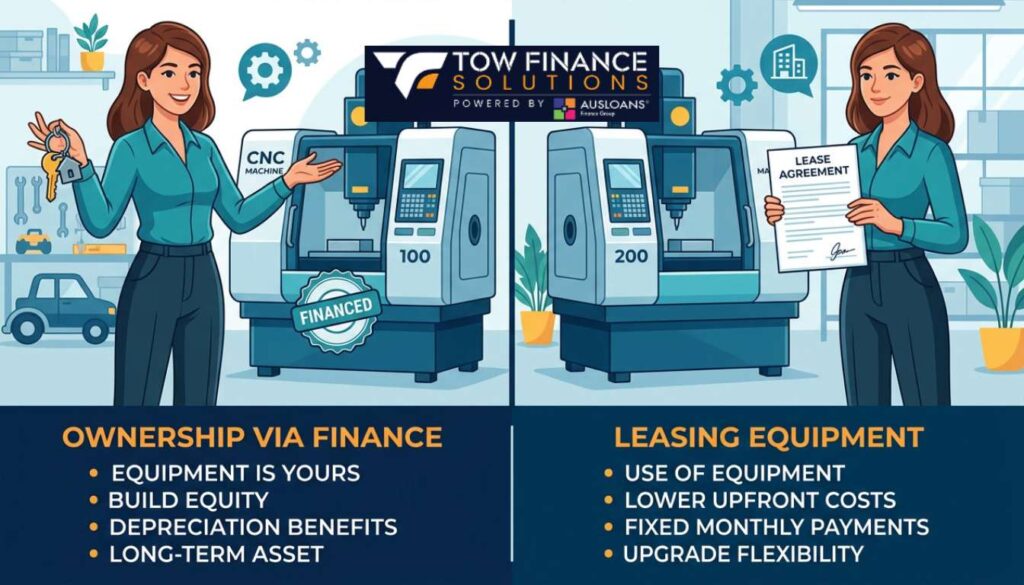
Equipment finance gives you ownership of the asset from day one, while leasing lets you use it without owning it. The best choice depends on your tax position, cash flow, and whether you plan to keep the equipment long term. For most Australian small businesses seeking immediate tax deductions and equity in their assets, equipment finance (typically structured as a chattel mortgage) is the stronger option. Leasing suits businesses that upgrade frequently or prefer predictable operating expenses.

According to the Australian Bureau of Statistics, business investment in machinery and equipment rose 13% in the September quarter of 2025, the strongest quarterly jump in over four years. Australian companies are planning to invest $202.8 billion in capital expenditure during FY26, a 7.4% increase on the prior year. With that level of spending, choosing the right funding structure is not a minor detail. It directly affects your bottom line.

Tow Finance Solutions works with over 40 lenders to match your business with the right finance structure for equipment purchases, whether that is a chattel mortgage, hire purchase, finance lease, or operating lease. This guide breaks down both options so you can move forward with confidence.

Key Takeaways

  • Equipment finance (chattel mortgage) provides immediate asset ownership, GST credits, and depreciation deductions.
  • Leasing (finance lease or operating lease) keeps the asset off your balance sheet and allows regular upgrades.
  • The ATO’s $20,000 instant asset write-off applies until 30 June 2026 for owned assets only, not leased ones.
  • Chattel mortgage rates in 2025 typically range from 7% to 11% p.a., while finance lease rates sit around 8% to 12% p.a.
  • Around 65% of Australian business vehicle and equipment finance uses chattel mortgage structures.
  • A finance broker like Tow Finance Solutions can compare both options across 40+ lenders in as little as one hour.

Find The Best Deal

cropped-view-of-business-partners-shaking-hands-an-SUBGQMC.jpg

With over 10 years of industry experience we are a leading independent broker with a diverse panel of 40 + lenders to find you the best solution, tailored to you and your goals!

What Is Equipment Finance?

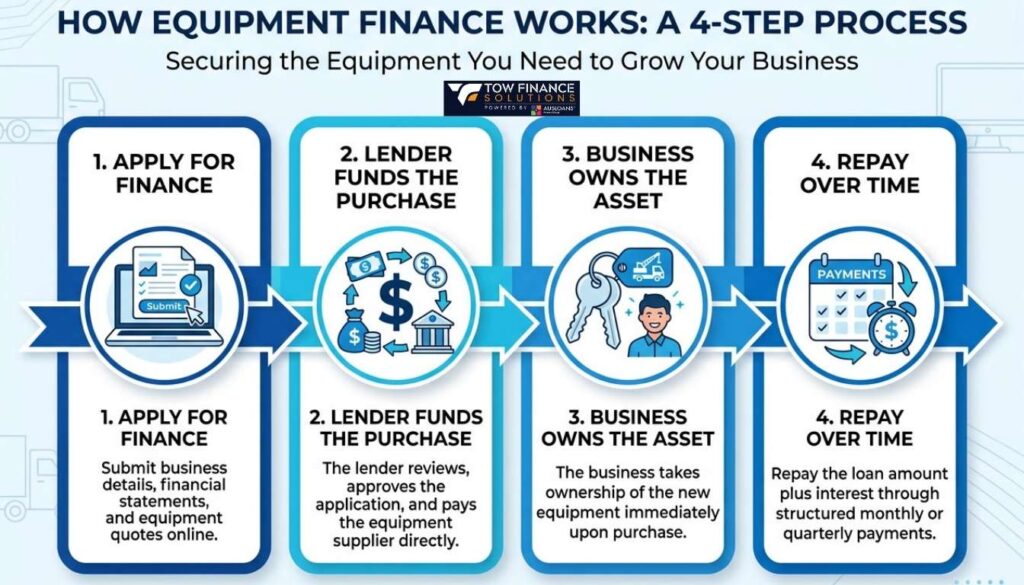
Equipment finance is a loan used to purchase business assets outright. Your business takes ownership immediately, and the lender holds the asset as security until the loan is fully repaid. The most common structure in Australia is the chattel mortgage, which literally means a “mortgage over moveable goods.”

Under a chattel mortgage, you borrow the full purchase price (minus any deposit), then repay in fixed monthly instalments over 1 to 7 years. You can include an optional balloon payment (also called a residual) at the end of the term, which lowers your monthly repayments but leaves a lump sum owing at maturity.

According to Money.com.au borrower data from 2025, the average chattel mortgage amount requested for vehicles is $71,430, and $157,728 for machinery or equipment. The vast majority of requests (84%) come from small businesses with 1 to 10 employees.

Because you own the asset from settlement, you can claim depreciation, deduct the interest component of repayments, and recover the full GST on the purchase price in your next BAS quarter. This combination of tax advantages is the primary reason chattel mortgages dominate Australian business finance.

“Chattel mortgage is often the most tax-effective option for GST-registered businesses using the cash accounting method. It allows immediate GST claims and depreciation deductions,” notes the Australian asset finance industry guidance published by Easy Asset Finance in 2025.

What Is Leasing?

Leasing allows your business to use equipment for a fixed period without purchasing it. The financier buys the asset and rents it to you under agreed terms. At the end of the lease, you typically choose between returning the equipment, extending the lease, or purchasing it at the residual value.

There are two main types of leases relevant to Australian businesses:

Finance Lease: The lender owns the asset, but the risks and rewards of ownership effectively transfer to you. The asset usually appears on your balance sheet under AASB 16 accounting standards. You make regular lease payments, and GST is claimed progressively on each payment rather than upfront. You cannot claim depreciation because you do not legally own the asset.

Operating Lease: The lender retains both ownership and the risks of ownership. Payments are treated as a pure operating expense, and the asset stays off your balance sheet entirely. This structure is common for equipment with rapid obsolescence, like IT hardware or medical technology.

According to industry data, finance leases account for roughly 25% of Australian business asset finance arrangements, with the remaining 10% split between hire purchase and other structures. Leasing is particularly popular among businesses that rotate equipment every 2 to 4 years or need to preserve working capital for other priorities.

If you are weighing your loan options, understanding how leasing differs from secured ownership structures is essential.

How equipment leasing works

Equipment Finance vs Leasing: Side-by-Side Comparison

The table below compares the two structures across the factors that matter most to Australian business owners.

Feature

Equipment Finance (Chattel Mortgage)

Leasing (Finance Lease)

Ownership

You own the asset from day one

Lender owns the asset during the term

GST Treatment

Full GST claimed upfront on next BAS

GST claimed progressively on each payment

Depreciation

Claimable under ATO schedules

Not claimable (lender owns the asset)

Interest Deductions

Interest component is tax-deductible

Entire lease payment is tax-deductible

Instant Asset Write-Off

Eligible (assets under $20,000, turnover under $10M)

Not eligible

Balance Sheet

Asset and liability both recorded

May appear under AASB 16 requirements

Typical Rates (2025)

7% to 11% p.a.

8% to 12% p.a.

End of Term

You own the asset outright

Return, extend, or purchase at residual

Best For

Long-term assets, tax maximisation

Frequent upgrades, lower monthly outlay

This comparison highlights why the decision is not simply about monthly repayments. The tax and cash flow implications differ substantially depending on your business structure and goals.

Tax Implications: What the ATO Says

Tax treatment is the single biggest differentiator between equipment finance and leasing. Understanding how the ATO treats each structure prevents costly mistakes.

Instant Asset Write-Off (2025-26)

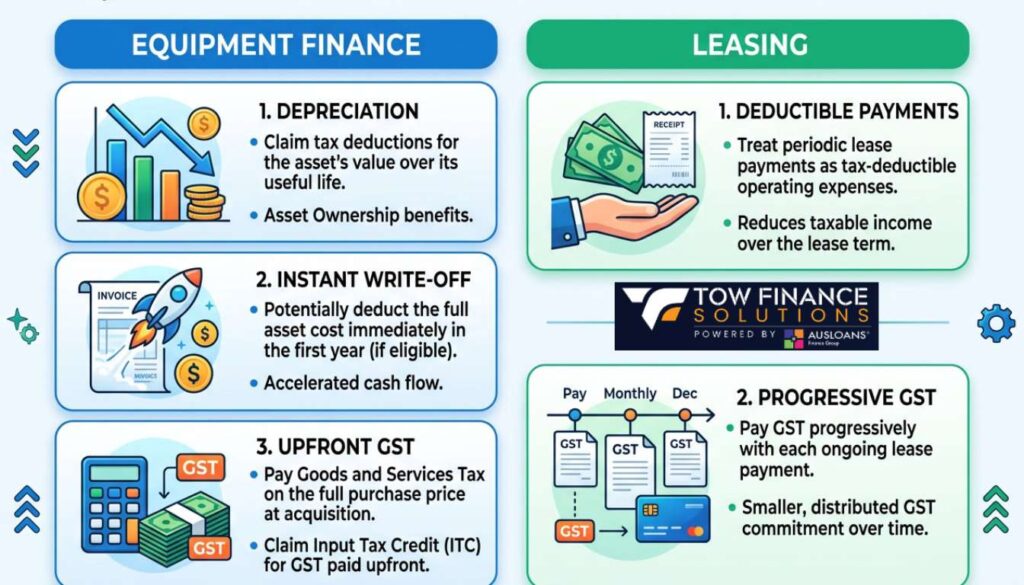
The Australian Government extended the $20,000 instant asset write-off until 30 June 2026 under the Treasury Laws Amendment (Strengthening Financial Systems and Other Measures) Act 2025. Small businesses with aggregated turnover under $10 million can immediately deduct the full cost of eligible assets costing less than $20,000 per item.

This benefit only applies when you own the asset. Under a chattel mortgage or hire purchase, the business takes ownership at settlement, making the asset eligible. Under a finance lease, the lender retains ownership, so the write-off does not apply. For a $19,500 asset purchased under a chattel mortgage, a business on the 25% small business tax rate saves approximately $4,875 in tax that financial year. Under a finance lease, that saving is unavailable.

Depreciation

Owned assets are depreciated according to ATO effective life schedules. You can choose either the diminishing value method (which front-loads deductions in earlier years) or the prime cost method (which spreads deductions evenly). Assets worth $20,000 or more are placed into the small business depreciation pool at 15% in the first year and 30% in subsequent years.

With a finance lease, you cannot claim depreciation because the lender owns the asset. Instead, the entire lease payment is deductible as an operating expense. For businesses with seasonal cash flow, that predictable deduction can simplify tax planning.

GST Credits

Under a chattel mortgage, a GST-registered business claims the full GST on the purchase price in the BAS quarter the asset is acquired. For a $60,000 commercial vehicle, that is a $6,000 GST credit returned to your business almost immediately.

Under a finance lease, GST is claimed incrementally on each lease payment. The total GST recovered over the lease term is the same, but you do not get the large upfront cash flow benefit.

Note: For passenger vehicles, the ATO caps the GST credit at 1/11th of the car depreciation limit. For 2025-26, the car limit is $69,674, capping the maximum GST claim at $6,334.

Business Equipment Finance 2

When Equipment Finance Is the Better Choice

Equipment finance is the stronger option when your business wants to build equity and maximise tax deductions. Choose this structure if:

  • You plan to keep the equipment for 5 or more years.
  • Your business has strong taxable income and benefits from front-loaded depreciation.
  • You are GST-registered and want the immediate cash flow boost of an upfront GST credit.
  • The asset retains value over time (e.g., heavy machinery, commercial vehicles, earthmoving equipment).
  • You want the freedom to modify, customise, or sell the equipment at any time without lender restrictions.

A practical example: a landscaping business purchasing a $55,000 excavator under a chattel mortgage takes ownership at settlement, claims the $5,000 GST back on the next BAS, and begins depreciating the asset immediately. Over a 5-year term with a 20% balloon, monthly repayments are manageable, and the business builds full equity in a high-value asset.

If you are looking into vehicle financing for your fleet, chattel mortgage is the go-to structure for most Australian operators.

When Leasing Is the Better Choice

Leasing wins when flexibility and cash preservation matter more than ownership. Choose a lease if:

  • You work in an industry where technology changes rapidly (IT, medical, hospitality).
  • Your business upgrades equipment every 2 to 4 years.
  • You want consistent, predictable monthly expenses without large upfront costs.
  • You prefer not to carry the asset and associated liability on your balance sheet.
  • Your cash reserves are limited and you need to preserve working capital for growth.

Operating leases, in particular, suit businesses that view equipment as a tool rather than an investment. The financier takes on the residual value risk, meaning you are not left holding an obsolete asset when the term ends.

For businesses managing cash flow fluctuations, leasing provides cost certainty that helps with budgeting.

Business Equipment Financing

How a Finance Broker Helps You Choose

The difference between equipment finance and leasing is not just theoretical. Rate spreads, lender policies, and tax implications vary significantly depending on the asset type, your business structure, and your credit profile.

A finance broker compares options across multiple lenders and structures, rather than locking you into a single bank’s product. According to ABS data, around 97.3% of Australian businesses are small businesses, and most lack the in-house expertise to navigate complex asset finance structures alone.

Tow Finance Solutions gives you access to 40+ lenders, with loan approvals in as little as one hour. Whether you need a chattel mortgage for a $200,000 excavator or a finance lease for $15,000 worth of IT hardware, Tow Finance Solutions’ dedicated consultants guide you through every step of the process.

Working with a broker also helps protect your credit score because your application is matched to lenders most likely to approve, reducing unnecessary hard inquiries.

Frequently Asked Questions

What is the main difference between equipment finance and leasing?

Equipment finance (chattel mortgage) gives your business ownership of the asset from day one. A lease means the financier owns the asset and you pay to use it for an agreed term. Ownership determines your tax treatment, GST credits, and what happens at the end of the agreement.

Can I claim the instant asset write-off on a leased asset?

No. The ATO’s $20,000 instant asset write-off (valid until 30 June 2026) requires that your business owns the asset. Under a finance lease, the lender retains ownership, so the deduction is not available. You would need a chattel mortgage or hire purchase structure to qualify.

Which option has lower monthly repayments?

Leasing typically offers lower monthly payments because the residual value is built into the structure. Chattel mortgages can achieve comparable repayments by including a balloon payment at the end of the term, though this creates a lump sum obligation at maturity.

Is equipment finance better for tax purposes?

For most GST-registered small businesses, yes. A chattel mortgage allows you to claim the full GST upfront, deduct interest on repayments, and claim depreciation annually. Leasing offers simpler tax administration with fully deductible lease payments, but you miss out on depreciation and the instant asset write-off.

What happens at the end of a lease?

At the end of a finance lease, you can return the equipment, extend the lease, or purchase the asset at the pre-agreed residual value. With an operating lease, you typically return the equipment unless renewal is negotiated.

How do interest rates compare between equipment finance and leasing?

In 2025, chattel mortgage rates typically ranged from 7% to 11% p.a., while finance lease rates sat between 8% to 12% p.a. The rate differential of 0.5% to 1.5% reflects the lender’s residual value risk under a lease structure. A broker like Tow Finance Solutions can help secure competitive rates across both options.

Do I need a deposit for equipment finance?

It depends on the lender, asset type, and your business profile. Some lenders offer zero-deposit chattel mortgages for established businesses with strong credit. Others may require 10% to 20% upfront. Tow Finance Solutions compares loan options across its panel to find the best terms for your situation.

Can I finance second-hand equipment?

Yes. Both chattel mortgages and finance leases can be used for second-hand equipment, though lenders may impose age limits and condition requirements. The ATO’s instant asset write-off does not distinguish between new and used assets, provided all other eligibility criteria are met.

What types of equipment can I finance or lease?

Virtually any business asset qualifies, including vehicles, trucks, excavators, medical equipment, hospitality fit-outs, IT hardware, manufacturing machinery, and agricultural equipment. Tow Finance Solutions arranges finance across a wide range of asset categories.

How long does approval take?

With Tow Finance Solutions, approvals can be completed in as little as 12-24 hours. The application process is fully online, and a dedicated consultant handles the lender comparison and paperwork on your behalf.

Take the Next Step

Choosing between equipment finance and leasing is one of the most impactful financial decisions your business will make this year. The right structure saves thousands in tax, protects your cash flow, and sets you up for long-term growth.

Tow Finance Solutions makes the process fast and simple. With access to 40+ lenders, approvals in as little as an hour, and personalised guidance from dedicated consultants, you get the right equipment finance structure for your business without the guesswork.

Apply now or call (07) 4410 3375 to speak with a Tow Finance Solutions consultant today.

Take the Next Step

Self-employed Australians deserve the same access to competitive finance as everyone else. The difference between approval and rejection often comes down to preparation, documentation, and choosing the right lender, not your employment status.

Tow Finance Solutions specialises in finding the right fit from a panel of 40+ lenders, with approvals in as little as one hour and a process built to protect your credit score. Whether you need a car, a business vehicle, or asset finance to grow your operations, the team is ready to help.

Apply online today or call (07) 4410 3375 to speak with a dedicated consultant about your self-employed finance options.

Sources

our partner lenders
Categories
Loan guide

Self-Employed? Here’s How to Get Approved for Car or Business Finance

Self-Employed? Here's How to Get Approved for Car or Business Finance

April 17, 2026

Getting approved for car or business finance when you’re self-employed is absolutely achievable, but it requires a different approach than a standard PAYG application. Lenders assess self-employed applicants based on income consistency, business stability, and documentation quality rather than simple payslips.

According to the Australian Bureau of Statistics, over 2 million Australians are self-employed, representing roughly 16% of the total workforce. Yet many sole traders, contractors, and business owners believe financing is out of reach because their income fluctuates or their tax returns show lower net figures. The reality is that dozens of lenders actively welcome self-employed borrowers, and a finance broker with access to a broad lender panel can match you with the right one.

This article breaks down exactly what self-employed applicants need to know about qualifying for car finance or business finance, from documentation requirements to approval strategies that actually work.

Key Takeaways

  • Self-employed borrowers can access the same competitive rates as PAYG applicants with the right preparation and lender match.
  • Documentation is the single biggest factor in approval. Organised financials dramatically improve your chances.
  • A finance broker with access to 40+ lenders can identify options specifically designed for ABN holders and sole traders.
  • Trading history, BAS statements, and bank statements often matter more than tax returns alone.
  • Structuring your application correctly from the start avoids unnecessary credit enquiries that can hurt your credit score.

Find The Best Deal

cropped-view-of-business-partners-shaking-hands-an-SUBGQMC.jpg

With over 10 years of industry experience we are a leading independent broker with a diverse panel of 40 + lenders to find you the best solution, tailored to you and your goals!

Overview

This guide covers why self-employed applications differ from PAYG, the exact documents lenders want to see, strategies to strengthen your application, common mistakes to avoid, and how working with a specialist broker simplifies the entire process. Whether you need a vehicle for personal use or a fleet of assets for your growing business, the path to approval starts with understanding what lenders actually look for.

Why Self-Employed Finance Applications Are Different

Why Self-Employed Finance Applications Are Different

Income Verification Is More Complex

PAYG employees hand over two payslips and a group certificate. Self-employed applicants don’t have that luxury. Lenders need to verify that your income is real, consistent, and sufficient to cover repayments.

The Australian Taxation Office reports that small businesses account for 97% of all Australian businesses. Lenders know this market is enormous, but they also know self-employed income can vary month to month. That variability is what makes documentation so critical.

Most lenders look at a combination of business activity statements (BAS), tax returns, bank statements, and accountant declarations. The specific mix depends on the lender and how long you’ve been trading. Some lenders accept as little as 6 months of BAS statements, while others require two full years of tax returns.

Tax Minimisation Creates a Catch-22

Here’s the tension every self-employed borrower faces: your accountant works hard to minimise your taxable income, but lenders assess your borrowing capacity based on that same taxable income. A business earning $180,000 in revenue might show $65,000 in net profit after deductions, and lenders base their calculations on that lower figure.

This doesn’t mean you’re stuck. Many lenders use “add-back” calculations, where they add depreciation, one-off expenses, or other non-cash deductions back into your income figure to get a more realistic picture of your actual earning capacity. The key is working with a broker who knows which lenders offer these add-back policies.

What Documents Do You Need?

Having the right paperwork ready before you apply is the fastest way to streamline your approval. According to the Australian Securities and Investments Commission (ASIC), responsible lending obligations require lenders to verify income through documented evidence, not verbal declarations.

For Self-Employed Applicants Trading Over 2 Years

  • Last two years of personal and business tax returns
  • Most recent Notice of Assessment from the ATO
  • Last 6-12 months of business bank statements
  • Current BAS statements (typically last 4 quarters)
  • ABN registration confirmation
  • Valid driver’s licence and proof of address

For Self-Employed Applicants Trading Under 2 Years

  • Last 6-12 months of BAS statements
  • Business bank statements showing consistent revenue
  • Accountant’s letter or declaration confirming income
  • ABN registration details and GST registration (if applicable)
  • Evidence of industry experience or prior employment in the same field

Low-Doc and No-Doc Options

Some lenders offer low-documentation loans for self-employed borrowers who can’t provide full financials. These typically require a signed income declaration, 3-6 months of bank statements, and a valid ABN registered for at least 12 months. Interest rates on low-doc products are generally 0.5% to 2% higher than full-doc equivalents, but they provide a genuine pathway when traditional documentation isn’t available.

Understanding the difference between pre-qualification and pre-approval can also help you gauge where you stand before committing to a full application.

How to Strengthen Your Application Before You Apply

How to Strengthen Your Application Before You Apply

1. Get Your Financials in Order Early

Don’t wait until you need finance to organise your books. Lenders want clean, consistent records. Ensure your BAS is lodged on time, your bank statements show regular deposits, and your accountant has current figures ready.

According to the Council of Small Business Organisations of Australia, businesses with up-to-date financial records are significantly more likely to secure financing on favourable terms. Preparation is the single highest-impact step you can take.

2. Separate Personal and Business Banking

Lenders scrutinise bank statements closely. Mixing personal and business transactions makes it harder to verify business income and raises red flags. If you haven’t already, open a dedicated business account and run all business revenue and expenses through it.

3. Manage Your Credit Profile

Every finance application triggers a credit enquiry. Multiple enquiries in a short period signal desperation to lenders and can lower your credit score. This is exactly why working with a broker matters: they submit one application to the right lender rather than letting you shotgun applications across multiple providers.

Learn more about protecting your score in our guide on how to boost your loan approval odds.

4. Reduce Existing Debt Where Possible

Lenders calculate your debt-to-income ratio to determine repayment capacity. Paying down credit cards, personal loans, or unused credit facilities before applying can meaningfully improve your borrowing power. Even closing a credit card you don’t use removes its limit from your liabilities.

5. Save a Larger Deposit

A deposit of 10-20% reduces the lender’s risk and often unlocks better interest rates. For business vehicle financing, a deposit can also reduce your monthly repayments and improve cash flow, which is especially valuable for seasonal businesses.

Car Finance Options for Self-Employed Borrowers

Self-employed Australians have access to several car finance structures, each with different benefits depending on whether the vehicle is for personal or business use.

Chattel Mortgage

A chattel mortgage is one of the most popular options for self-employed borrowers purchasing a vehicle for business use. You own the vehicle from day one, the interest and depreciation are tax-deductible, and you can claim the GST on the purchase price upfront. This structure works well for sole traders and companies registered for GST.

Consumer Car Loan (Secured)

For personal vehicle purchases, a secured car loan uses the vehicle as collateral, which typically results in lower interest rates compared to unsecured options. Approval depends on your income documentation and credit history rather than the purpose of the vehicle.

Lease Arrangements

Operating leases and finance leases suit self-employed borrowers who prefer lower monthly payments or want to upgrade vehicles regularly. Lease payments are generally tax-deductible as a business expense, though the tax treatment differs from a chattel mortgage. Your accountant can advise on which structure provides the best outcome for your specific situation.

Understanding how balloon payments work is also important, as many self-employed borrowers use balloon structures to keep repayments manageable during the loan term.

Business Finance Options for Self-Employed Borrowers

Beyond vehicle finance, self-employed operators often need funding for equipment, cash flow, or business growth. The right product depends on what you need the funds for and how quickly you need them.

Equipment and Asset Finance

Purpose-built for purchasing business assets like machinery, tools, technology, or vehicles. The asset itself secures the loan, which means approval criteria can be more flexible than unsecured lending. Lenders focus heavily on the asset’s value and your ability to service the repayment.

Business Line of Credit

A business line of credit provides a revolving credit facility you draw on as needed. This is ideal for managing irregular cash flow, covering short-term gaps, or funding opportunities as they arise. You only pay interest on what you use.

Short-Term and Medium-Term Business Loans

For specific projects or purchases, a term loan provides a lump sum with fixed repayments over a set period. Businesses dealing with seasonal cash flow challenges may find flexible repayment structures particularly useful.

Why a Finance Broker Makes the Difference

Applying directly to a bank as a self-employed borrower often leads to frustration. Banks have rigid criteria, and if your application doesn’t fit their box, you get declined, which leaves a mark on your credit file.

A specialist finance broker like Tow Finance Solutions works differently. With access to over 40 lenders, a broker assesses your situation first, identifies lenders whose criteria match your profile, and submits your application where it’s most likely to succeed.

“Self-employed borrowers often have stronger financial positions than their tax returns suggest,” says a senior lending consultant. “The broker’s job is to present the full picture to the right lender, not force a square peg into a round hole.”

Tow Finance Solutions offers approvals in as little as one hour, with a process designed to protect your credit score by minimising unnecessary enquiries. The online application takes minutes, and a dedicated consultant guides you through every step.

Common Mistakes Self-Employed Borrowers Make

Applying to multiple lenders simultaneously. Each application creates a credit enquiry. Three or four enquiries in a week can drop your score and make subsequent applications harder. Always use a broker to target the right lender first.

Financing Challenges

Not lodging BAS on time. Late or missing BAS lodgements signal poor financial management to lenders. The ATO’s lodgement program sets clear deadlines, and lenders check compliance as part of their assessment.

Underestimating the importance of bank statements. Lenders review your transaction history for gambling activity, dishonour fees, and overall spending behaviour. Clean bank statements with consistent deposits are one of the strongest indicators of reliability.

Failing to disclose all liabilities. Lenders conduct credit checks and cross-reference your declarations. Undisclosed debts, including buy-now-pay-later accounts, create trust issues that can derail an otherwise strong application.

Avoid these and other critical errors outlined in our guide to the top mistakes to avoid when applying for a loan.

Frequently Asked Questions

Can I get car finance with only 6 months of ABN history? Yes. Several lenders accept applicants with as little as 6 months of ABN registration, provided you can supply BAS statements and bank statements showing consistent income. A broker can match you with these specific lenders quickly.

Do self-employed borrowers pay higher interest rates? Not necessarily. With full documentation and a strong credit profile, self-employed applicants can access the same competitive rates as PAYG borrowers. Low-doc applications typically carry a small premium of 0.5% to 2%.

What if my tax returns show low income due to deductions? Many lenders use add-back policies that account for depreciation, one-off expenses, and other non-cash deductions. Your broker presents your income in the most favourable, accurate light by matching you with lenders who apply these calculations.

Can I finance a vehicle for both personal and business use? Yes. The finance structure you choose (chattel mortgage, consumer loan, or lease) will depend on the primary use and your tax situation. Your accountant and broker can work together to find the best fit.

How long does approval take for self-employed applicants? With Tow Finance Solutions, approvals can happen in as little as 1 hour when documentation is complete. Complex applications involving low-doc products may take 24-48 hours. Learn more about car finance approval timelines.

Do I need a guarantor as a self-employed borrower? Not usually. Most self-employed applications are assessed on your own income and credit history. However, a guarantor can strengthen a borderline application or help you access better rates.

Will applying for finance affect my credit score? Every formal application creates a credit enquiry, but working with a broker minimises this risk. Tow Finance Solutions’ process is designed for credit score protection, submitting applications strategically rather than broadly.

What’s the difference between a chattel mortgage and a car loan? A chattel mortgage is a business finance product where you own the vehicle and claim tax deductions on interest and depreciation. A standard car loan is a consumer product without those business tax benefits. Your choice depends on the vehicle’s use.

Can I get finance if I have a default on my credit file? Yes, though options may be more limited. Some lenders within Tow Finance Solutions’ panel specialise in credit-impaired applicants. Being upfront about defaults and demonstrating improved financial behaviour strengthens your case.

What’s the minimum deposit required? Some lenders offer 100% financing with no deposit for strong applicants. However, a 10-20% deposit improves your approval odds, reduces your repayment amount, and may unlock lower interest rates.

Take the Next Step

Self-employed Australians deserve the same access to competitive finance as everyone else. The difference between approval and rejection often comes down to preparation, documentation, and choosing the right lender, not your employment status.

Tow Finance Solutions specialises in finding the right fit from a panel of 40+ lenders, with approvals in as little as one hour and a process built to protect your credit score. Whether you need a car, a business vehicle, or asset finance to grow your operations, the team is ready to help.

Apply online today or call (07) 4410 3375 to speak with a dedicated consultant about your self-employed finance options.

Sources

  • Australian Bureau of Statistics — Labour Force, Australia: abs.gov.au
  • Australian Taxation Office — Small Business Overview: ato.gov.au
  • Australian Securities and Investments Commission — Responsible Lending Obligations: asic.gov.au
  • Council of Small Business Organisations of Australia: cosboa.org.au
our partner lenders
Categories
Loan guide

Fixed vs Variable Rate Loans: Which Is Right for Your Car or Leisure Finance?

Finance Your Dream Boat, Camper Trailer, or Jet Ski Without Breaking the Bank

Jan 09, 2025

Choosing between a fixed and variable rate loan is one of the most important decisions borrowers face when financing a car, boat, caravan, or other leisure asset. The rate structure you select directly affects your monthly repayments, total interest costs, and financial flexibility over the life of your loan.

Both options have distinct advantages depending on your financial situation, risk tolerance, and how long you plan to keep the asset. Understanding these differences helps borrowers make confident decisions that align with their budget and lifestyle goals. This guide breaks down both rate types, compares their benefits and drawbacks, and provides practical guidance for choosing the right structure for your next car finance or leisure finance purchase.

Overview

This article covers the fundamental differences between fixed and variable rate loans, explores the pros and cons of each option, examines real-world scenarios for car and leisure buyers, and provides a decision framework to help you choose. You will also find answers to frequently asked questions and guidance on getting the best rate for your circumstances.

Find The Best Deal

cropped-view-of-business-partners-shaking-hands-an-SUBGQMC.jpg

With over 10 years of industry experience we are a leading independent broker with a diverse panel of 40 + lenders to find you the best solution, tailored to you and your goals!

Key Takeaways

  • Fixed rate loans lock in your interest rate for the loan term, providing predictable repayments regardless of market changes.
  • Variable rate loans fluctuate with market conditions, potentially saving money when rates drop but increasing costs when rates rise.
  • Fixed rates suit borrowers who prioritise budget certainty and protection against rate increases.
  • Variable rates may benefit those who can absorb payment fluctuations and want flexibility features like extra repayments.
  • Your choice should reflect your financial stability, risk tolerance, loan term, and current economic conditions.

What Is a Fixed Rate Loan?

A fixed rate loan locks your interest rate at the time of approval, meaning your repayments remain identical throughout the agreed fixed period—typically one to seven years for vehicle and leisure finance. This structure shields borrowers from market volatility and Reserve Bank of Australia (RBA) cash rate movements.

Fixed rate loans are particularly popular among buyers who value predictability. When you know exactly what you will pay each fortnight or month, budgeting becomes straightforward. This certainty proves especially valuable for families, first-time borrowers, or anyone financing a significant purchase like a new car or boat, camper trailer, or jet ski.

However, fixed rates often come with restrictions. Most fixed rate products limit or penalise extra repayments, and break costs may apply if you pay out the loan early. These trade-offs are worth considering if you anticipate changes to your financial situation during the loan term.

What Is a Variable Rate Loan?

A variable rate loan has an interest rate that moves up or down based on market conditions, typically influenced by the RBA cash rate and lender funding costs. When rates fall, your repayments decrease; when rates rise, your repayments increase accordingly.

Variable loans generally offer greater flexibility than their fixed counterparts. Most allow unlimited extra repayments without penalty, and some include redraw facilities that let you access additional funds you have paid in. This flexibility appeals to borrowers who may receive bonuses, tax refunds, or irregular income and want the option to pay down their loan faster.

The trade-off is uncertainty. Borrowers must be comfortable with the possibility that their repayments could increase, sometimes significantly, if interest rates rise. Understanding how interest rates impact your financing choices helps you prepare for this variability.

Fixed vs Variable: A Direct Comparison

Repayment Predictability

Fixed rate loans offer complete repayment certainty. Your monthly or fortnightly amount stays the same, making it simple to plan household budgets and manage cash flow. Variable loans require more active monitoring, as repayments can change with little notice following rate adjustments.

Flexibility and Extra Payments

Variable loans typically allow borrowers to make extra repayments without penalty, potentially shortening the loan term and reducing total interest paid. Fixed loans often cap additional payments or charge fees for exceeding limits. If paying off your loan early is a priority, this distinction matters significantly.

Early Payout and Break Costs

Exiting a fixed rate loan before the term ends may trigger break costs—fees designed to compensate the lender for lost interest revenue. These costs can be substantial depending on remaining term length and rate differentials. Variable loans rarely carry such penalties, offering more freedom to refinance or pay out the loan when circumstances change.

Interest Rate Risk

Fixed rates protect against increases but prevent you from benefiting if rates fall. Variable rates expose you to both upside and downside movements. Your comfort with financial uncertainty should guide this decision. Those exploring the impact of inflation on leisure finance will find this consideration particularly relevant in the current economic environment.

When Fixed Rates Make Sense

Fixed rate loans work best for borrowers who prioritise stability and want protection against rising interest rates. Consider a fixed rate if you have a tight household budget with little room for payment increases, are financing over a longer term where rate volatility has more time to affect costs, believe interest rates are likely to rise based on economic indicators, or simply prefer knowing exactly what you will pay each month.

First-time borrowers often benefit from fixed rates while they establish their financial footing. The predictability removes one variable from an already significant financial commitment. Before applying, reviewing a step-by-step guide to getting a car loan can help you prepare.

When Variable Rates Make Sense

Variable rate loans suit borrowers with financial flexibility who can absorb potential payment increases. This option may work better if you have a comfortable income buffer and can handle repayment fluctuations, want to make extra repayments to pay off your loan faster, plan to sell the asset or refinance before the loan term ends, or believe interest rates are stable or likely to decrease.

Buyers financing leisure assets like boats or caravans sometimes prefer variable rates because they may sell or upgrade within a few years. Avoiding break costs provides valuable flexibility for those whose plans may change. Understanding your leisure finance repayment strategies helps maximise the benefits of a variable structure.

Split Rate Loans: A Middle Ground

Some lenders offer split rate loans that divide your borrowing between fixed and variable portions. This hybrid approach provides partial protection against rate rises while retaining some flexibility for extra repayments on the variable portion.

Split loans can be a sensible compromise for borrowers who see merit in both structures. However, they add complexity and may not be available from all lenders. Working with a broker who has access to a diverse lending network increases your chances of finding a suitable split product.

How to Choose the Right Rate Structure

Selecting between fixed and variable rates requires honest assessment of your financial position and preferences. Start by evaluating your income stability—borrowers with reliable, predictable income can more confidently manage variable rate uncertainty, while those with irregular earnings may prefer fixed rate security.

Consider your loan term as well. Shorter loans of one to three years experience less cumulative impact from rate changes, making variable structures lower risk. Longer terms amplify the effects of rate movements in either direction. Think also about your plans for the asset, since selling or trading within a few years favours variable rates to avoid potential break costs.

Finally, assess current market conditions. When rates sit at historic lows, locking in a fixed rate protects against likely increases. When rates are elevated, variable loans position you to benefit from potential decreases. Economic commentary and RBA announcements provide useful guidance, though no one can predict future movements with certainty.

Getting the Best Rate Regardless of Structure

Whether you choose fixed or variable, several factors influence the rate you will receive. Your credit score significantly impacts lender offers, so improving a low credit score before applying can secure better terms. The loan-to-value ratio matters as well—larger deposits or equity typically attract lower rates.

Comparing multiple lenders is essential. Rates vary considerably across the market, and choosing the right loan provider involves more than just headline rates. Consider comparison rates that include fees, lender reputation, and customer service quality.

Watch for hidden fees in loan agreements that can erode the benefit of a low rate. Establishment fees, ongoing account fees, and early exit penalties all affect total loan cost. Using a loan calculator helps you understand the true cost under different scenarios.

Frequently Asked Questions

Can I switch from a fixed rate to a variable rate during my loan?

Switching mid-term is possible but typically incurs break costs on fixed rate loans. These costs can be significant depending on remaining term and rate differentials. Review your loan contract or speak with your lender before making changes.

Are fixed rates always higher than variable rates?

Not always. Fixed rates are priced based on lender predictions of future rate movements. When markets expect rates to fall, fixed rates may be lower than current variable rates. Compare both options at the time of application.

How often do variable rates change?

Variable rates can change at any time, though most adjustments follow RBA cash rate announcements (typically monthly). Lenders may also adjust rates independently based on their funding costs.

Do fixed rate loans allow extra repayments?

Most fixed rate loans permit limited extra repayments, often capped at $5,000 to $10,000 per year. Exceeding these limits may trigger fees. Check your specific loan terms before making additional payments.

Which rate type is better for boat or caravan finance?

It depends on your plans. If you intend to keep the asset long-term and want budget certainty, fixed rates provide security. If you may sell or upgrade within a few years, variable rates offer flexibility without break cost concerns.

What are break costs and how are they calculated?

Break costs compensate lenders when borrowers exit fixed loans early. They are calculated based on the difference between your fixed rate and current market rates, multiplied by remaining term and loan balance. Costs vary significantly by circumstance.

Should I get pre-approval before deciding on a rate type?

Yes. Pre-approved loans confirm your borrowing capacity and often lock in available rates, giving you clarity when comparing fixed and variable options.

How does loan term affect the fixed vs variable decision?

Longer terms increase exposure to rate changes, making fixed rates more protective but also more restrictive. Shorter terms reduce rate volatility impact, making variable rates relatively lower risk.

Can I negotiate my interest rate?

Yes, particularly through a broker with access to multiple lenders. Competition between lenders creates room for negotiation, especially for borrowers with strong credit profiles and solid deposits.

What is the difference between headline rate and comparison rate?

The headline rate is the base interest rate advertised. The comparison rate includes mandatory fees and charges, providing a more accurate picture of total loan cost. Always compare using comparison rates.

Sources

Ready to Find Your Best Rate?

Whether you prefer the certainty of fixed rates or the flexibility of variable, Tow Finance Solutions can match you with the right lender from our panel of 40+ finance providers. Apply Now for a personalised quote or Contact Our Team to discuss your options.

our partner lenders
Categories
Loan guide

Understanding Loan Pre-Qualification vs. Pre-Approval: Your Complete Guide to Getting Started Right

Understanding Loan Pre-Qualification vs. Pre-Approval

Your Complete Guide to Getting Started Right

Nov 18, 2025

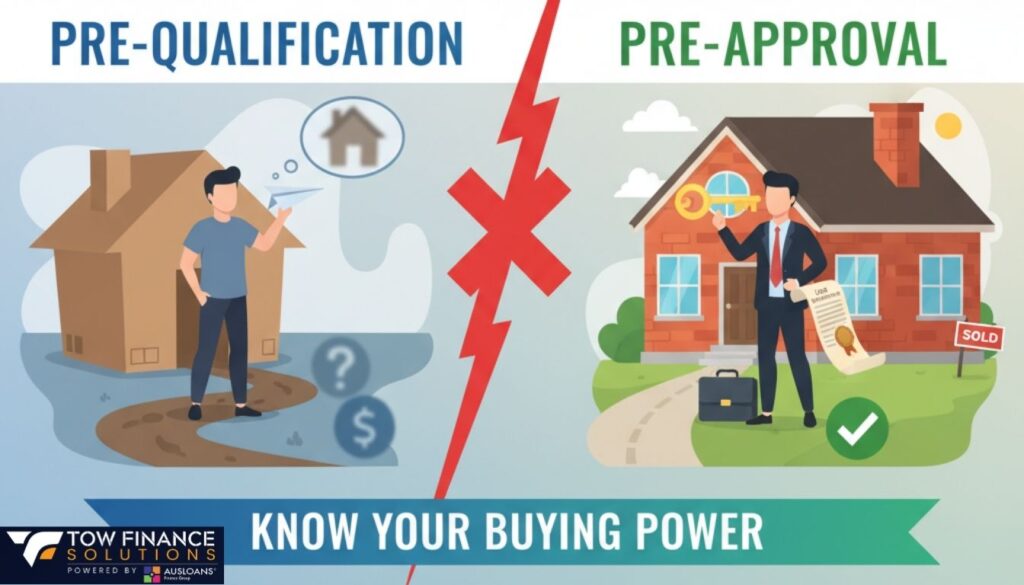
Navigating the world of financing can feel overwhelming, especially when you encounter terms like “pre-qualification” and “pre-approval.” While these terms sound similar, they represent distinctly different stages in the loan application process, each offering unique benefits and requiring different levels of commitment from both you and your lender.

Understanding the difference between pre-qualification and pre-approval is crucial for making informed financing decisions, whether you’re seeking vehicle finance, business funding, or leisure equipment loans. At Tow Finance Solutions, we help customers navigate these early stages with clarity and confidence, ensuring you choose the right path for your specific needs. Our streamlined processes and diverse network of 40+ lenders mean you can move efficiently from initial inquiry to final approval, often within hours rather than days.

Overview

This comprehensive guide will walk you through everything you need to know about loan pre-qualification and pre-approval. You’ll discover the key differences between these two processes, understand when to use each approach, and learn how to leverage both to strengthen your financing position. We’ll also explore how these preliminary steps can accelerate your final loan approval and help you secure better terms.

By the end of this article, you’ll have a clear understanding of how to approach the early stages of financing strategically, setting yourself up for success whether you’re purchasing a vehicle, expanding your business, or financing recreational equipment.

Find The Best Deal

cropped-view-of-business-partners-shaking-hands-an-SUBGQMC.jpg

With over 10 years of industry experience we are a leading independent broker with a diverse panel of 40 + lenders to find you the best solution, tailored to you and your goals!

Key Takeaways

  • Pre-qualification provides a quick estimate based on basic information you provide, with no credit check required 
  • Pre-approval involves a thorough review of your financial situation, including a credit check, resulting in a conditional loan commitment 
  • Pre-approval carries more weight with sellers and gives you stronger negotiating power 
  • Both processes can help you understand your budget and financing options before making major purchases 
  • Pre-qualification is ideal for initial budgeting, while pre-approval is essential for serious shopping 
  • Neither guarantees final loan approval, but pre-approval gets you much closer to a firm commitment 
  • Working with experienced brokers like Tow Finance Solutions can streamline both processes significantly

What is Loan Pre-Qualification?

Loan Pre Qualification

The Basics of Pre-Qualification

Loan pre-qualification is an informal assessment that gives you a preliminary idea of how much you might be able to borrow and at what interest rate. This process typically involves providing basic financial information to a lender or broker, who then uses this information to estimate your borrowing capacity without conducting a formal credit check.

During pre-qualification, you’ll typically share details about your income, employment status, existing debts, and the amount you’re looking to borrow. The lender uses this information to provide an estimate based on their general lending criteria. This process is usually quick, often completed within minutes, and can frequently be done online or over the phone.

Pre-qualification serves as an excellent starting point for understanding your financing options. It helps you establish a realistic budget before you begin shopping for vehicles, equipment, or making business investments. However, it’s important to understand that pre-qualification is not a guarantee of lending, and the final terms may differ significantly once a thorough review is conducted.

Benefits of Pre-Qualification

Pre-qualification offers several advantages, particularly for those in the early stages of considering a purchase. First, it provides valuable insight into your potential borrowing capacity without any commitment from either party. This information helps you set realistic expectations and focus your search on options within your likely price range.

The process is also completely free and doesn’t impact your credit score, since most lenders perform only a soft credit inquiry or rely entirely on the information you provide. This means you can explore multiple options without concern about affecting your credit rating. Additionally, pre-qualification can often be completed quickly, sometimes within minutes, making it an efficient first step in your financing journey.

Pre-qualification also helps you understand the general market conditions and what different lenders might offer. When working with a broker like Tow Finance Solutions, pre-qualification allows you to quickly assess options across our extensive network of over 40 lenders, giving you a broad view of potential terms and conditions before committing to a formal application.

Limitations of Pre-Qualification

While pre-qualification is useful, it has significant limitations that borrowers should understand. The estimates provided are based on limited information and general lending guidelines, not a thorough review of your complete financial picture. This means the actual terms offered during formal application may vary considerably from the pre-qualification estimate.

Pre-qualification typically doesn’t include verification of the information you provide. Lenders assume the accuracy of your stated income, debts, and other financial details. When these details are formally verified during the application process, discrepancies may lead to different terms or even denial of the loan.

The preliminary nature of pre-qualification also means it carries little weight in competitive buying situations. Sellers, particularly in hot markets, may give preference to buyers with more substantial proof of financing capability. Pre-qualification alone may not be sufficient to demonstrate serious intent or financial capacity to complete a purchase.

What is Loan Pre-Approval?

Understanding the Pre-Approval Process

Loan pre-approval is a much more comprehensive evaluation that involves a thorough review of your financial situation. During this process, lenders examine your credit history, verify your income and employment, review bank statements, and assess your overall debt-to-income ratio. This detailed analysis allows them to make a conditional commitment to lend you a specific amount at predetermined terms.

The pre-approval process typically requires you to complete a formal loan application and provide extensive documentation. This might include recent pay stubs, tax returns, bank statements, and details about existing debts and assets. The lender will also perform a hard credit inquiry, which may temporarily impact your credit score but provides them with a complete picture of your credit history.

Upon successful completion of the pre-approval process, you’ll receive a pre-approval letter or certificate that specifies the loan amount, interest rate, and basic terms for which you qualify. This document represents a conditional commitment from the lender, subject to final verification and approval of the specific item you’re financing.

Advantages of Pre-Approval

Pre-approval offers significant advantages over pre-qualification, particularly when you’re ready to make serious purchase decisions. The most important benefit is the credibility it provides with sellers. A pre-approval letter demonstrates that you have undergone thorough financial scrutiny and that a lender has made a conditional commitment to finance your purchase.

This credibility can be crucial in competitive markets or when negotiating with sellers. Many sellers prefer to work with pre-approved buyers because it reduces the risk of financing-related delays or deal failures. In some cases, pre-approval can give you an advantage over other potential buyers who lack this documentation.

Pre-approval also provides you with a clear understanding of your financing terms before you begin shopping. You’ll know exactly how much you can borrow, what your interest rate will be, and what your monthly payments are likely to be. This knowledge allows you to shop with confidence and make decisions quickly when you find the right opportunity.

Pre-Approval Requirements and Timeline

The pre-approval process requires more time and documentation than pre-qualification, but the investment often pays dividends in terms of credibility and certainty. Most lenders require recent pay stubs (typically the last two months), tax returns from the previous year or two, bank statements showing account balances and transaction history, and a complete list of existing debts and monthly obligations.

Employment verification is also standard, and some lenders may contact your employer directly to confirm your position and income. Self-employed individuals may need to provide additional documentation, such as profit and loss statements or business bank statements. The specific requirements can vary between lenders and loan types.

The timeline for pre-approval varies depending on the lender and the complexity of your financial situation. With traditional lenders, the process might take several days to a week. However, experienced brokers like Tow Finance Solutions can often expedite this process significantly, sometimes achieving pre-approval within hours by leveraging relationships with lenders and streamlined application processes.

Key Differences Between Pre-Qualification and Pre-Approval

Supporting Image (2)

Documentation Requirements

The documentation requirements represent one of the most significant differences between pre-qualification and pre-approval. Pre-qualification typically requires only basic information that you can provide verbally or through a simple online form. This might include your estimated income, employment status, approximate debt levels, and the loan amount you’re considering.

Pre-approval, in contrast, requires extensive documentation to verify every aspect of your financial situation. Lenders want to see proof of income through pay stubs and tax returns, verification of assets through bank statements, confirmation of employment, and detailed information about existing debts and obligations. This documentation allows lenders to make informed decisions based on verified facts rather than estimates.

The documentation phase of pre-approval can be time-consuming, but it’s also where much of the value lies. By thoroughly reviewing your financial situation upfront, lenders can provide more accurate terms and identify potential issues before you find something you want to purchase. This thorough review also means that final approval is typically much faster once you’ve identified your specific purchase.

Credit Impact Considerations

One of the most important practical differences between pre-qualification and pre-approval relates to the impact on your credit score. Pre-qualification typically involves only a soft credit inquiry, which doesn’t affect your credit score. Some pre-qualification processes don’t involve any credit check at all, relying entirely on the information you provide.

Pre-approval almost always requires a hard credit inquiry, which can temporarily lower your credit score by a few points. However, this impact is generally minimal and short-lived, especially if you’re not applying for multiple types of credit simultaneously. The credit bureaus recognize that consumers often shop around for the best rates, so multiple inquiries for the same type of loan within a short period are typically treated as a single inquiry.

When working with brokers like Tow Finance Solutions, it’s important to understand that we use processes designed to minimize negative impact on your credit score. Our experienced team can often determine the best lender options before initiating formal applications, reducing the number of hard inquiries needed to secure optimal financing.

Level of Commitment

The level of commitment from both parties differs significantly between pre-qualification and pre-approval. Pre-qualification represents minimal commitment from either side. The lender provides estimates based on limited information, and you’re under no obligation to proceed with that lender or even to pursue financing at all.

Pre-approval represents a much higher level of commitment from the lender. After thoroughly reviewing your financial situation, the lender makes a conditional commitment to provide financing at specific terms. While this commitment is still subject to final approval and verification of the item being financed, it represents a much stronger assurance than pre-qualification.

From your perspective, pursuing pre-approval also represents a higher level of commitment to moving forward with a purchase. The time and effort required to gather documentation and complete the application process indicates serious intent to proceed with financing. This mutual commitment often leads to smoother transactions and faster final approvals.

When to Choose Pre-Qualification vs. Pre-Approval

Ideal Scenarios for Pre-Qualification

Pre-qualification is ideal when you’re in the early stages of considering a purchase and want to understand your general financing options without making a firm commitment. If you’re still deciding whether to buy a vehicle, expand your business, or make another significant purchase, pre-qualification can help you understand what might be possible without affecting your credit score.

Pre-qualification is also useful when you want to compare options across multiple lenders or types of financing. Since the process is quick and doesn’t impact your credit, you can easily gather estimates from various sources to understand the range of terms available. This information can help you make informed decisions about timing, loan amounts, and which lenders to pursue for formal applications.

If you’re planning a purchase several months in the future, pre-qualification can help you understand what steps you might need to take to improve your financing position. For example, you might discover that paying down certain debts or increasing your down payment could significantly improve your terms. This early insight allows you to take action before you need financing.

When Pre-Approval Makes Sense

Pre-approval is essential when you’re ready to make serious purchase decisions and want the credibility and negotiating power that comes with verified financing. If you’re planning to shop for vehicles, equipment, or other financed items within the next few weeks or months, pre-approval ensures you can act quickly when you find the right opportunity.

Pre-approval is also valuable when you’re entering competitive markets where sellers have multiple options. Having pre-approval documentation demonstrates that you’re a serious buyer with verified financing capability. This can be particularly important for business equipment purchases or in markets where financing contingencies might make your offer less attractive.

If you have a complex financial situation, pre-approval can help identify and resolve potential issues before you find something you want to purchase. Self-employed individuals, those with recent credit issues, or buyers with non-traditional income sources often benefit from addressing any documentation or qualification concerns early in the process.

Strategic Timing Considerations

The timing of when you pursue pre-qualification versus pre-approval can significantly impact your financing experience. Generally, it’s wise to start with pre-qualification early in your consideration process, then move to pre-approval as you get closer to making a purchase decision.

For most purchases, pursuing pre-approval 30-60 days before you plan to buy provides optimal timing. This gives you enough time to address any issues that arise during the approval process while ensuring the pre-approval remains current when you’re ready to purchase. Most pre-approval letters are valid for 60-90 days, though specific timeframes vary by lender.

It’s also important to consider market conditions when timing your pre-approval. In fast-moving markets, having current pre-approval can be crucial for making competitive offers. However, if you’re planning to shop for an extended period, you might want to delay pre-approval until closer to your purchase timeline to ensure the terms remain current and valid.

Impact on Your Credit Score

Understanding Credit Inquiries

When considering pre-qualification and pre-approval, it’s essential to understand how each process affects your credit score. Credit inquiries fall into two categories: soft inquiries and hard inquiries. Soft inquiries don’t affect your credit score and include things like checking your own credit, pre-qualification assessments, and background checks by existing creditors.

Hard inquiries do impact your credit score and occur when you formally apply for credit. These inquiries can lower your score by a few points, typically 2-5 points, and remain on your credit report for two years. However, their impact on your score diminishes over time, with most of the effect disappearing after about six months.

The good news is that credit scoring models recognize that consumers often shop around for the best rates on loans. When you have multiple hard inquiries for the same type of loan within a short period (typically 14-45 days, depending on the scoring model), they’re usually treated as a single inquiry for scoring purposes. This allows you to compare offers without dramatically impacting your credit score.

Managing Multiple Applications

If you’re considering multiple financing options, it’s important to manage the timing of your applications strategically. For pre-qualification, since most processes use soft inquiries, you can generally explore multiple options without credit score concerns. This allows you to gather a comprehensive view of your options before moving to formal applications.

For pre-approval, it’s wise to complete your shopping within a focused timeframe to take advantage of the inquiry grouping mentioned above. At Tow Finance Solutions, we help manage this process by identifying the best lender options based on your profile before initiating formal applications. This targeted approach minimizes the number of hard inquiries needed.

It’s also important to avoid applying for other types of credit during your financing process. If you’re shopping for vehicle finance, avoid applying for credit cards, personal loans, or other unrelated credit products during the same period. Multiple types of credit inquiries don’t benefit from the same grouping treatment and can have a more significant impact on your score.

Protecting Your Credit During the Process

There are several steps you can take to protect your credit score during the financing process. First, be honest and accurate about your intentions when speaking with lenders. If you’re just exploring options, make it clear that you’re seeking pre-qualification rather than formal pre-approval. This helps ensure that only soft inquiries are performed.

When you’re ready for pre-approval, gather all necessary documentation before beginning the process. Having everything ready allows you to complete applications quickly and efficiently, reducing the timeframe over which hard inquiries occur. This organization also demonstrates preparation to lenders, which can positively influence their decision-making process.

Consider working with experienced brokers like Tow Finance Solutions who understand credit protection strategies. Our team can help you navigate the process in a way that minimizes credit impact while maximizing your approval chances. We understand which lenders are most likely to approve your application, reducing the need for multiple attempts.

Common Misconceptions and Mistakes

Myths About Pre-Qualification and Pre-Approval

One common misconception is that pre-qualification and pre-approval are guarantees of final loan approval. While both processes provide valuable insights into your likely approval and terms, neither represents a firm commitment to lend. Pre-qualification is particularly preliminary, based on limited information and general guidelines rather than thorough verification.

Another myth is that pre-approval locks in your interest rate permanently. Most pre-approval letters include rate estimates based on current market conditions, but final rates are typically determined at the time of loan closing. Interest rates can change between pre-approval and final approval, particularly if market conditions shift or if there’s a significant delay between approval and purchase.

Some borrowers also believe that once they’re pre-approved with one lender, they can’t or shouldn’t explore other options. In reality, pre-approval from one lender can actually strengthen your position when negotiating with others. Having a firm offer in hand gives you leverage and confidence when exploring alternative financing options.

Documentation Errors to Avoid

One of the most common mistakes in the pre-approval process is providing incomplete or inaccurate documentation. This might include outdated pay stubs, incomplete tax returns, or bank statements that don’t show required time periods. These errors can delay the approval process significantly and may require starting over with updated documentation.

Another frequent error is failing to disclose existing debts or obligations. Some applicants focus only on major debts like mortgages and car loans while overlooking credit card balances, personal loans, or other obligations. Lenders will discover these debts during their review, and failing to disclose them upfront can damage your credibility and potentially lead to denial.

Self-employed borrowers often struggle with documentation requirements, sometimes providing business documents when personal income verification is needed, or vice versa. Understanding exactly what documentation is required for your employment situation is crucial for a smooth approval process. Working with experienced professionals can help ensure you provide the right documents in the right format.

Timing and Expectation Mistakes

Many borrowers make timing mistakes that can complicate their financing process. Starting the pre-approval process too early might result in expired approvals by the time you’re ready to purchase. Starting too late might leave you scrambling to complete documentation while trying to finalize a purchase, potentially missing opportunities or accepting less favorable terms.

Unrealistic expectations about approval timelines can also cause problems. While some lenders can provide quick decisions, complex applications or unusual circumstances may require additional time for review. Planning for potential delays and starting the process with adequate buffer time helps ensure you’re not pressured into poor decisions.

Another common mistake is assuming that the first pre-approval offer is the best available. Different lenders have different strengths and preferences, and terms can vary significantly between institutions. Taking time to compare offers, especially when working with brokers who have access to multiple lenders, often results in better terms and conditions.

Tips for a Successful Application Process

Preparing Your Financial Documentation

Success in both pre-qualification and pre-approval often comes down to preparation and organization. Start by gathering all potentially required documents before beginning any formal application process. This includes recent pay stubs, tax returns, bank statements, documentation of other income sources, and a list of all existing debts and monthly obligations.

For employed individuals, ensure your pay stubs are recent (typically within 30 days) and clearly show year-to-date earnings. If you’ve recently changed jobs, be prepared to provide documentation from both your current and previous employers. Employment gaps or changes may require additional explanation, so prepare clear, honest explanations for any unusual circumstances.

Self-employed individuals should focus on demonstrating stable, consistent income through tax returns, profit and loss statements, and business bank statements. Having an accountant prepare or review your financial documentation can add credibility and ensure everything is presented clearly and professionally.

Optimizing Your Application Timing

Timing your application strategically can significantly impact your success and the terms you receive. Generally, avoid applying during periods when your financial situation is in flux, such as immediately after changing jobs, during tax season when processing might be slower, or when you’re carrying unusually high credit card balances.

Consider the timing of large purchases or financial changes that might affect your application. For example, if you’re planning to pay off credit cards or make a large deposit, consider completing these actions before applying if they’ll improve your financial profile. However, avoid making major financial changes during the application process without discussing them with your lender first.

Market conditions can also affect timing. Interest rates, lender appetite for certain types of loans, and seasonal factors can all influence the terms available to you. Experienced brokers like Tow Finance Solutions can provide guidance on market timing and help you understand when conditions might be most favorable for your application.

Working Effectively with Lenders and Brokers

Communication is key to a successful financing experience. Be honest and upfront about your financial situation, including any challenges or unusual circumstances. Lenders and brokers are experienced in working with various situations, and early disclosure of potential issues allows them to address concerns proactively rather than discovering problems later in the process.

Ask questions about anything you don’t understand, including terms, requirements, and timelines. A good lender or broker should be willing to explain the process clearly and help you understand your options. Don’t hesitate to seek clarification on documentation requirements, approval conditions, or any other aspects of the process.

When working with brokers like Tow Finance Solutions, take advantage of their expertise and lender relationships. We can provide insights into which lenders are most likely to approve your application, what terms you might expect, and how to present your application most effectively. Our experience often allows us to anticipate and address potential issues before they become problems.

Industry Best Practices and Standards

Regulatory Compliance and Consumer Protection

The lending industry operates under extensive regulatory oversight designed to protect consumers and ensure fair lending practices. The Truth in Lending Act requires lenders to provide clear disclosure of loan terms, including interest rates, fees, and payment schedules. The Equal Credit Opportunity Act prohibits discrimination based on race, gender, marital status, religion, or other protected characteristics.

These regulations extend to both pre-qualification and pre-approval processes. Lenders must provide accurate information about potential terms and cannot mislead consumers about their likelihood of approval or the terms they might receive. When rate ranges are provided, they must be based on actual lending decisions rather than theoretical minimums that few borrowers could achieve.

At Tow Finance Solutions, we ensure all our processes comply with applicable regulations and industry standards. Our team stays current with regulatory changes and works only with lenders who maintain high standards of compliance and customer service. This commitment to regulatory compliance protects both our customers and our business relationships.

Professional Standards in Finance Brokerage

Professional finance brokers adhere to industry standards that prioritize customer service, transparency, and ethical conduct. This includes providing clear explanations of the brokerage process, disclosing all fees and compensation arrangements, and maintaining confidentiality of customer financial information.

Quality brokers also maintain ongoing relationships with diverse lender networks and stay current with changing lending criteria and market conditions. This knowledge allows them to provide accurate guidance and match customers with appropriate lending options based on current market realities rather than outdated information.

Continuing education and professional development are also hallmarks of reputable finance brokers. The lending industry evolves constantly, with new products, regulations, and market conditions requiring ongoing learning and adaptation. At Tow Finance Solutions, our team participates in regular training and maintains industry certifications to ensure we provide the most current and accurate guidance to our customers.

Technology and Security Standards

Modern lending processes rely heavily on technology for application processing, document management, and communication. Industry-standard security measures include encryption of sensitive data, secure document transmission, and multi-factor authentication for access to customer information.

Reputable lenders and brokers also maintain appropriate insurance coverage and bonding to protect customer interests. This includes professional liability insurance, errors and omissions coverage, and in some cases, bonding requirements that provide additional protection for customer funds and information.

At Tow Finance Solutions, we use industry-leading technology platforms that meet or exceed security standards for financial services. Our systems are regularly audited and updated to ensure customer information remains secure throughout the application and approval process. We also maintain transparent policies about data use and sharing, giving customers clear understanding of how their information is handled.

Frequently Asked Questions

What’s the main difference between pre-qualification and pre-approval? Pre-qualification is a quick estimate based on basic information you provide, while pre-approval involves thorough verification of your finances including a credit check. Pre-approval results in a conditional loan commitment, whereas pre-qualification is just an estimate.

Does pre-qualification affect my credit score? No, pre-qualification typically uses only a soft credit inquiry or no credit check at all, so it won’t impact your credit score. You can explore multiple pre-qualification options without any credit concerns.

How long does pre-approval take? Pre-approval timelines vary by lender and application complexity. At Tow Finance Solutions, we often achieve pre-approval in as little as one hour for well-prepared applications, though complex situations may take longer.

Can I shop around after getting pre-approved? Yes, you can continue shopping for better terms even after pre-approval. Having a pre-approval in hand actually strengthens your negotiating position with other lenders and shows sellers you’re a serious buyer.

How long is pre-approval valid? Most pre-approval letters are valid for 60-90 days, though specific timeframes vary by lender. Some lenders may extend or update pre-approvals if your financial situation remains stable.

What documents do I need for pre-approval? Typical requirements include recent pay stubs, tax returns, bank statements, employment verification, and a list of existing debts. Self-employed individuals may need additional business documentation.

Will pre-approval guarantee my loan? Pre-approval is a conditional commitment based on verification of your finances, but final approval depends on the specific item being financed and final underwriting review. It’s much stronger than pre-qualification but not a final guarantee.

Can I get pre-approved for different loan amounts? Yes, you can pursue pre-approval for different amounts or from multiple lenders. Just be mindful that each formal application may result in a hard credit inquiry, so plan your applications strategically.

Should I get pre-qualified or pre-approved first? Start with pre-qualification to understand your general options, then move to pre-approval when you’re ready to shop seriously. Pre-qualification helps with initial budgeting, while pre-approval gives you credibility with sellers.

How does working with a broker affect these processes? Brokers like Tow Finance Solutions can streamline both processes by matching you with suitable lenders from their network, reducing the number of applications needed and often achieving better terms through established relationships.

Sources

  • Australian Securities and Investments Commission (ASIC) – Consumer Credit Information: https://www.asic.gov.au 
  • Reserve Bank of Australia – Interest Rates and Monetary Policy: https://www.rba.gov.au 
  • Australian Prudential Regulation Authority (APRA) – Banking Standards: https://www.apra.gov.au 
  • Fair Trading NSW – Consumer Credit Protection: https://www.fairtrading.nsw.gov.au 
  • Australian Competition and Consumer Commission (ACCC) – Consumer Rights: https://www.accc.gov.au 
  • Credit Ombudsman Service Australia – Consumer Protection: https://www.cosl.com.au

Ready to move forward with confidence? Whether you’re interested in pre-qualification to explore your options or ready for pre-approval to strengthen your purchasing power, contact our expert team today. With access to over 40 lenders and approvals possible in as little as one hour, Tow Finance Solutions makes your financing journey simple, fast, and successful.

our partner lenders
Categories
Loan guide

Bridging Loans: What They Are and When to Use Them

Bridging Loans: What They Are and When to Use Them

Oct 21, 2025

Bridging loans represent one of the most versatile and time-sensitive financing solutions available in today’s market, offering a crucial lifeline when traditional funding timelines don’t align with urgent financial needs. Whether you’re navigating a property purchase before selling your current home, securing business assets quickly, or managing cash flow gaps, bridging finance can provide the speed and flexibility required to capitalize on time-sensitive opportunities.

At Tow Finance Solutions, we understand that financial opportunities often come with tight deadlines. Our extensive network of over 40 lenders and commitment to fast approvals—often within just one hour—makes us uniquely positioned to help you secure bridging finance when every moment counts. With our personalized service approach and transparent processes, we ensure you understand exactly how bridging loans work and whether they’re the right solution for your specific situation.

Overview

This comprehensive guide will walk you through everything you need to know about bridging loans, from their fundamental mechanics to strategic applications across various scenarios. You’ll learn about the different types of bridging finance available, understand the costs and risks involved, and discover how to navigate the application process efficiently. We’ll also explore real-world scenarios where bridging loans prove invaluable and provide practical guidance on choosing the right lender and loan structure for your needs.

By the end of this article, you’ll have a clear understanding of when bridging loans make financial sense, how they compare to traditional financing options, and the steps needed to secure this type of interim financing quickly and effectively.

Find The Best Deal

cropped-view-of-business-partners-shaking-hands-an-SUBGQMC.jpg

With over 10 years of industry experience we are a leading independent broker with a diverse panel of 40 + lenders to find you the best solution, tailored to you and your goals!

Key Takeaways

• Bridging loans provide short-term financing solutions, typically lasting 6-24 months, designed to bridge gaps between financial transactions
• Interest rates are generally higher than traditional loans but offer unmatched speed and flexibility for time-sensitive opportunities
• Property transactions, business acquisitions, and cash flow management are the most common applications for bridging finance
• Fast approval processes can deliver funding within days rather than weeks or months required for conventional loans
• Exit strategies are crucial—you must have a clear plan for repaying the bridging loan before committing to the finance
• Working with experienced brokers like Tow Finance Solutions provides access to multiple lenders and competitive terms

What Are Bridging Loans?

Understanding the Fundamentals

Bridging loans, also known as bridge loans or interim financing, are short-term lending solutions designed to provide immediate capital while you wait for longer-term financing or the completion of a financial transaction. These loans literally “bridge” the gap between your immediate funding needs and your permanent financing solution, offering a temporary but essential financial lifeline.

Unlike traditional loans that may take weeks or months to approve and settle, bridging loans prioritize speed above all else. This rapid deployment of capital comes at a premium—interest rates are typically higher than conventional loans—but the ability to access funds within days or even hours can mean the difference between securing a lucrative opportunity and watching it slip away to competitors.

The typical bridging loan ranges from $50,000 to several million dollars, with terms usually spanning 6 to 24 months. Some lenders offer extensions, but the fundamental principle remains the same: these are temporary solutions requiring a clear exit strategy from day one.

How Bridging Loans Work

The mechanics of bridging loans are relatively straightforward but require careful planning and execution. When you apply for bridging finance, lenders focus primarily on the value of the asset being used as security and your ability to repay the loan through your planned exit strategy, rather than your ongoing income or debt-to-income ratios that dominate traditional loan assessments.

Most bridging loans are secured against property or other substantial assets, providing lenders with confidence in their ability to recover funds if needed. The loan-to-value (LVR) ratios typically range from 60% to 80%, depending on the asset type and your specific circumstances. Interest can be structured as monthly payments, capitalized (added to the loan balance), or rolled up until the loan’s conclusion.

The application process emphasizes speed without compromising due diligence. Lenders conduct rapid valuations, streamlined credit assessments, and focused legal reviews to deliver approval decisions within hours or days. This efficiency requires borrowers to provide complete, accurate documentation upfront and maintain realistic expectations about loan terms and costs.

Types of Bridging Finance

Closed bridging loans represent the most common and typically most affordable option. With these loans, you have a confirmed exit strategy and definite repayment date—such as an unconditional sale contract or pre-approved long-term financing. Lenders view these as lower risk, resulting in more competitive interest rates and loan terms.

Open bridging loans offer greater flexibility but come with higher costs and stricter lending criteria. These loans don’t have a definite exit date, relying instead on your ability to sell an asset or secure alternative financing within the loan term. While more expensive, open bridging loans provide valuable flexibility when timing is uncertain.

First charge bridging loans take priority over all other secured debts against your asset, offering lenders maximum security and borrowers the most competitive rates. Second charge bridging loans sit behind existing mortgages or other secured debts, carrying higher interest rates but allowing you to access additional funding without refinancing existing arrangements.

Bridging loans

When to Use Bridging Loans

Property Chain Scenarios

Property chains create some of the most compelling use cases for bridging finance, particularly in competitive markets where timing can determine success or failure. When you’ve found your ideal property but haven’t yet sold your current home, bridging loans enable you to proceed with confidence, securing the new property while maintaining the sale timeline for your existing asset.

This approach proves especially valuable in seller’s markets where desirable properties attract multiple offers and cash buyers often hold advantages. By securing bridging finance, you can effectively compete as a cash buyer, increasing your chances of acceptance while maintaining the flexibility to time your current property sale optimally.

Consider the scenario where your dream home becomes available but your current property sale is progressing slowly. Traditional financing would require you to either risk losing the new property or accept a potentially reduced price for a quick sale of your existing home. Bridging finance allows you to secure the new property immediately while optimizing the sale strategy for your current home, potentially saving or earning thousands of dollars through better timing.

Investment Property Opportunities

Investment property markets often reward speed and decisive action, making bridging loans invaluable tools for experienced investors. When below-market-value properties become available—whether through distressed sales, auctions, or private negotiations—the ability to act quickly often determines profitability.

Renovation projects represent another prime application for bridging finance. Traditional lenders typically avoid properties requiring significant work, but bridging lenders focus on the improved value post-renovation. This allows investors to purchase, renovate, and refinance properties that would otherwise remain inaccessible through conventional financing channels.

Portfolio expansion strategies frequently utilize bridging loans to maintain momentum without disrupting existing financing arrangements. Rather than refinancing entire property portfolios to access equity, investors can use bridging finance to secure new acquisitions while arranging optimal long-term financing separately. This approach often proves more cost-effective and operationally efficient than traditional refinancing routes.

Business and Commercial Applications

Business bridging loans address urgent funding requirements that can’t wait for traditional business loan processing timeframes. Equipment purchases, stock acquisitions, or business acquisition opportunities often require immediate capital deployment to prevent competitors from securing advantages or suppliers from moving to alternative buyers.

Commercial property transactions frequently rely on bridging finance, particularly in competitive markets where vendor financing isn’t available and traditional commercial loans require extensive processing periods. The ability to settle quickly can secure prime locations or investment-grade properties that would otherwise be unattainable.

Cash flow management represents another crucial application, particularly for businesses with seasonal revenue patterns or those awaiting large contract payments. Rather than declining opportunities due to temporary cash constraints, bridging loans provide the working capital needed to maintain operations and capitalize on growth opportunities. For businesses seeking comprehensive financing solutions, bridging loans often complement longer-term funding strategies effectively.

Development and Construction Projects

Property development projects often require funding before traditional development finance becomes available, creating perfect scenarios for bridging loan applications. Site acquisitions, planning applications, and pre-construction activities frequently need funding while developers arrange comprehensive development finance packages.

Construction projects may encounter timing mismatches between funding requirements and traditional construction loan availability. Bridging finance can cover initial stages while ensuring development timelines remain on track. This proves particularly valuable for smaller developments where traditional lenders may be hesitant to provide early-stage funding.

Subdivision projects commonly utilize bridging loans to purchase large parcels before subdivision approval and infrastructure completion. This strategy allows developers to secure sites at lower pre-subdivision prices while arranging long-term financing based on the improved subdivision values.

Costs and Considerations

Interest Rates and Fees

Bridging loan interest rates typically range from 0.75% to 2% per month, translating to annual rates between 9% and 24%, significantly higher than traditional mortgage rates. This premium reflects the speed, flexibility, and risk profile associated with short-term lending. However, when calculated over actual usage periods—often just a few months—the total interest cost may be surprisingly reasonable compared to opportunity costs of delayed transactions.

Setup fees generally range from 1% to 2% of the loan amount, covering application processing, legal costs, and valuation expenses. Exit fees may apply, though many lenders waive these charges if borrowers refinance with their institution for long-term financing. Monthly management fees are common, typically ranging from $50 to $200 monthly, covering ongoing administration and account management.

Understanding the total cost of borrowing requires careful calculation of all fees and charges over the expected loan duration. While headline interest rates appear high, the short-term nature of bridging loans means total interest payments may be comparable to or less than the opportunity costs of missing time-sensitive transactions or the holding costs associated with maintaining dual properties.

Risk Assessment and Management

The primary risk in bridging finance lies in exit strategy failure—scenarios where your planned repayment method doesn’t materialize as expected. Property sales may take longer than anticipated, long-term financing approval may be delayed, or business cash flows may not develop as projected. Careful scenario planning and contingency preparation are essential risk management strategies.

Interest rate risk exists throughout the loan term, as most bridging loans use variable rates tied to market conditions. While loan terms are typically short, significant rate increases can materially impact total borrowing costs. Some lenders offer rate caps or fixed-rate options for additional fees, providing cost certainty for borrowers with tight profit margins.

Asset value risk affects all secured lending but carries particular importance in bridging finance due to higher loan-to-value ratios and shorter timeframes for value recovery. Market downturns or asset-specific issues could create situations where security values fall below outstanding loan balances, particularly if exit strategies are delayed significantly.

Legal and Regulatory Considerations

Bridging loans must comply with responsible lending obligations, requiring lenders to assess your ability to repay the loan through realistic exit strategies rather than ongoing income sources. This assessment focuses on asset values, sale probabilities, and refinancing feasibility rather than traditional income multiples used in conventional lending.

Consumer protection laws apply differently to bridging finance, particularly for loans secured against residential properties used as family homes. These loans may fall under additional regulatory oversight, including mandatory cooling-off periods and enhanced disclosure requirements that can affect settlement timelines.

Professional advice becomes crucial given the complexity and speed of bridging loan transactions. Legal representation, independent financial advice, and property valuations should be arranged early in the process to avoid delays and ensure full understanding of obligations and risks involved.

Bridging loan on a car

The Application Process

Pre-Application Preparation

Successful bridging loan applications require comprehensive preparation before engaging with lenders, as the speed emphasis means little time for gathering additional documentation once the process begins. Start by clearly defining your exit strategy—whether through property sale, long-term refinancing, or business cash flow—and gathering evidence supporting its feasibility and timeline.

Financial documentation should include recent tax returns, bank statements, asset valuations, and debt statements. For property-related loans, obtain recent sales evidence for comparable properties and professional opinions on sale timelines and expected prices. Business bridging loans require additional documentation including cash flow forecasts, contract evidence, and business valuations where relevant.

Professional advisors should be engaged early, including solicitors familiar with bridging finance, accountants capable of preparing detailed financial projections, and property professionals for valuation and sale strategy advice. Having these relationships established before application submission can significantly accelerate the approval and settlement process. Consider reviewing our guide on choosing the perfect loan provider to understand key selection criteria.

Lender Selection and Comparison

Bridging loan lenders vary significantly in their specializations, criteria, and processing capabilities. Traditional banks typically offer lower rates but longer processing times and stricter criteria. Specialist bridging lenders prioritize speed and flexibility but may charge higher rates. Non-bank lenders often provide the most innovative solutions but require careful assessment of their track record and financial stability.

Geographic considerations matter, as some lenders specialize in particular states or property types. Urban versus rural property locations can significantly affect lender appetite and pricing. Commercial bridging lenders may focus on specific sectors or deal sizes, making specialist knowledge crucial for complex transactions.

Processing speed varies dramatically between lenders, with some capable of same-day approvals while others require several days or weeks. Understanding each lender’s typical timelines and requirements allows for realistic planning and appropriate lender selection based on your specific urgency requirements. Working with experienced brokers like Tow Finance Solutions provides access to diverse lending networks and professional guidance on optimal lender selection.

Documentation and Approval Timeline

Standard documentation includes completed application forms, identity verification, income evidence, asset valuations, and detailed exit strategy documentation. Property-related applications require contracts of sale, council rates notices, insurance documentation, and legal title searches. Business applications need additional financial statements, business plans, and contract documentation supporting the funding purpose.

Valuation arrangements often determine application timelines, with desktop valuations available within hours while full physical inspections may require several days. Lenders typically arrange valuations directly with their approved panels, though borrower-commissioned valuations may be accepted in some circumstances to accelerate processing.

Legal reviews focus on title searches, existing encumbrances, and security documentation preparation. Experienced bridging finance solicitors can expedite this process significantly, while general practice lawyers may create delays through unfamiliarity with bridging loan requirements and documentation standards.

Settlement timelines typically range from 24 hours to two weeks, depending on complexity and lender processes. Same-day settlements are possible for straightforward applications with complete documentation and desktop valuations, while complex commercial transactions may require extended timeframes for comprehensive due diligence completion.

Alternatives to Bridging Loans

Traditional Bank Loans

Conventional bank loans offer significantly lower interest rates and longer repayment terms but require extended processing periods that may not suit time-sensitive opportunities. Traditional mortgages typically take 2-6 weeks for approval and settlement, making them unsuitable for urgent transactions but potentially more cost-effective for borrowers with flexible timelines.

Personal loans and lines of credit may provide faster access to smaller amounts but typically carry higher interest rates than mortgages and lower borrowing limits than bridging loans. These options work best for minor funding gaps rather than substantial property or business transactions requiring significant capital.

Equipment financing and specific asset loans may provide alternatives for business purposes, offering specialized terms and potentially better rates for particular asset types. However, these loans typically require longer processing periods and may not accommodate the urgency often driving bridging loan requirements.

Alternative Financing Solutions

Vendor financing arrangements allow property sellers to act as lenders, potentially offering more flexible terms and faster settlements than traditional lenders. This approach works particularly well when vendors are not under pressure to complete quickly and can benefit from ongoing income streams from the property sale.

Private money lenders and sophisticated investors sometimes provide bridging finance outside traditional lending channels. These arrangements can offer extremely fast processing and innovative structures but often carry higher costs and require careful assessment of lender credibility and contract terms.

Joint venture partnerships may provide alternatives for property development or investment scenarios, sharing both risks and returns rather than creating debt obligations. These structures require compatible partnership objectives and clear legal frameworks but can provide access to capital without traditional lending constraints.

Equity Release Options

Home equity loans and lines of credit against existing properties can provide access to capital without the costs associated with bridging finance. These solutions work best when timing pressure is moderate and borrowers have substantial equity in unencumbered properties.

Refinancing existing mortgages to access additional equity may prove more cost-effective than bridging loans for borrowers with sufficient lead time. Cash-out refinancing can provide substantial capital at mortgage rates rather than bridging loan premiums, though processing times are typically longer than bridging finance.

Investment property equity access through portfolio refinancing may enable property investors to fund new acquisitions without bridging loans. This approach requires comprehensive portfolio assessment and may affect existing loan arrangements, but can provide long-term financing at conventional rates.

Working with Tow Finance Solutions

While helping family members or friends secure financin

Tow Finance Solutions brings specialized expertise to bridging finance arrangements, with deep understanding of the unique requirements and challenges associated with short-term lending solutions. Our team has successfully arranged bridging loans across diverse scenarios, from residential property chains to complex commercial transactions, ensuring clients receive tailored solutions matching their specific circumstances and timeline requirements.

Our extensive network of over 40 lenders includes traditional banks, specialist bridging lenders, and private funding sources, providing access to competitive rates and flexible terms that might not be available through direct approaches. This broad lender panel enables us to match clients with lenders specializing in their particular transaction type, asset class, and risk profile.

The complexity of bridging finance demands experienced guidance to navigate application requirements, documentation preparation, and settlement coordination. Our consultants understand the critical importance of timing in bridging transactions and work proactively to identify and resolve potential delays before they impact settlement schedules.

Speed and Service Advantages

Our commitment to rapid service delivery aligns perfectly with the urgency typically driving bridging loan requirements. With approval decisions possible within hours and settlement capabilities within days, we ensure clients can capitalize on time-sensitive opportunities without compromise.

The streamlined application process we’ve developed minimizes documentation requirements while maintaining comprehensive lender assessment standards. Pre-application consultations help identify optimal lender matches and potential issues, enabling faster processing once formal applications are submitted.

Our dedicated relationship management approach ensures consistent communication throughout the application and settlement process. Clients receive regular updates on progress, immediate notification of any issues requiring attention, and proactive support to maintain settlement timelines. You can experience this personalized service by contacting our team directly.

Ongoing Support and Guidance

Bridging finance success extends beyond initial loan arrangement to include ongoing monitoring and exit strategy execution. Our team maintains regular contact throughout loan terms, providing support for refinancing arrangements, sale strategy optimization, and alternative exit route exploration if circumstances change.

Market condition monitoring helps clients understand optimal timing for exit strategy execution, whether through property sales, refinancing arrangements, or business cash flow development. This ongoing insight can significantly impact total transaction costs and success probability.

Post-transaction analysis and feedback help clients understand outcomes and optimize future financing strategies. This comprehensive approach ensures each bridging finance experience contributes to improved future decision-making and enhanced financial management capabilities.

g can be rewarding, becoming a guarantor involves significant risks that must be carefully considered. The most obvious risk is financial liability if the borrower defaults, but there are other important considerations that potential guarantors should understand.

The primary risk is being required to repay the full guaranteed amount plus associated costs if the borrower defaults. This obligation can arise suddenly and may strain the guarantor’s finances, particularly if they weren’t adequately prepared for this possibility.

Guarantor obligations can also affect the guarantor’s own borrowing capacity. Lenders treat guarantees as potential debts when assessing applications for mortgages, personal loans, or other financing. This can limit the guarantor’s ability to access credit for their own needs.

Major Risks for Guarantors:

• Full financial liability if the borrower defaults
• Reduced personal borrowing capacity due to guarantee obligations
• Potential impact on credit history if defaults occur
• Stress and relationship damage if repayment problems arise
• Limited ability to exit the guarantee once signed
• Possible legal action by lenders for debt recovery

Relationship and Emotional Considerations

Money-related agreements can strain even close relationships. Guarantors should consider how potential repayment difficulties might affect their relationship with the borrower. Open communication about expectations, repayment plans, and contingencies is essential.

It’s also important to consider the long-term nature of guarantee obligations. Car loans typically run for 5-7 years, while business loans can extend much longer. Guarantors must be comfortable with this extended commitment and potential liability.

Frequently Asked Questions

What is the minimum loan amount for bridging finance? Most lenders offer bridging loans starting from $50,000, though some specialists accommodate smaller amounts depending on the transaction type and security quality. The maximum amounts vary significantly, with commercial lenders capable of arranging facilities worth millions of dollars for suitable transactions.

How quickly can bridging loans be approved and settled? Approval times range from same-day to one week, depending on transaction complexity and documentation completeness. Settlement can occur within 24-48 hours for straightforward applications, though most transactions settle within 1-2 weeks. Working with experienced brokers like Tow Finance Solutions can significantly accelerate these timeframes.

Can I get bridging finance with bad credit? Bridging lenders focus primarily on asset security and exit strategy viability rather than credit history, making approval possible even with impaired credit records. However, poor credit may result in higher interest rates, lower loan-to-value ratios, or additional security requirements. Understanding how to fix a low credit score can improve your options.

What happens if I can’t repay the bridging loan on time? Most lenders offer extension options, typically for 3-6 month periods, though these incur additional fees and potentially higher interest rates. If extensions aren’t suitable, lenders may pursue asset sale to recover funds. Having multiple exit strategies and maintaining open communication with lenders helps avoid these scenarios.

Are bridging loans available for all property types? Most property types can secure bridging finance, including residential, commercial, industrial, and rural properties. However, lender appetite varies significantly based on location, condition, and marketability. Unique or specialized properties may require specialist lenders or attract higher interest rates.

Can bridging loans be used for business purposes beyond property? Yes, bridging finance can fund equipment purchases, stock acquisitions, working capital requirements, and business acquisitions. Business bridging loans typically require stronger exit strategies and may carry higher rates than property-secured facilities.

What’s the difference between bridging loans and construction loans? Construction loans are designed for building new properties or major renovations, releasing funds in stages as work progresses. Bridging loans provide lump sum funding for immediate requirements, though they can fund minor renovation works or pre-construction activities before traditional construction finance becomes available.

Do I need mortgage insurance for bridging loans? Lenders mortgage insurance isn’t typically required for bridging loans, as these facilities usually operate at lower loan-to-value ratios than traditional mortgages. However, property and contents insurance is mandatory, and some lenders may require additional insurance coverage depending on the asset type and loan structure.

Can I arrange bridging finance for overseas properties? Australian bridging lenders primarily focus on domestic properties, though some specialist lenders offer international bridging finance for experienced investors. Overseas transactions typically require higher deposits, more comprehensive documentation, and specialized legal advice regarding foreign investment regulations.

What documentation is needed for bridging loan applications? Essential documentation includes identity verification, income evidence, asset valuations, existing debt details, and comprehensive exit strategy documentation. Property transactions require contracts, title searches, and insurance details, while business applications need financial statements, business plans, and contract documentation supporting the funding purpose.

loan approved

Sources

  • Australian Securities and Investments Commission (ASIC) – Responsible Lending Guidelines 
  • Australian Prudential Regulation Authority (APRA) – Banking and Finance Regulations 
  • Reserve Bank of Australia – Interest Rate and Economic Data https://rba.gov.au
  • Australian Competition and Consumer Commission (ACCC) – Consumer Finance Protection 
  • Real Estate Institute of Australia – Property Market Data and Trends

Take Action on Your Financing Needs Today

Whether you’re navigating a complex property chain, seizing a time-sensitive investment opportunity, or addressing urgent business funding requirements, bridging loans offer the speed and flexibility needed to succeed in today’s competitive markets. The key to successful bridging finance lies in expert guidance, comprehensive planning, and access to the right lenders for your specific situation.

Don’t let timing constraints prevent you from achieving your financial goals. Apply now with Tow Finance Solutions and discover how our extensive lender network, rapid approval processes, and personalized service can deliver the bridging finance solution you need. Our experienced consultants are ready to assess your requirements and provide tailored recommendations that align with your timeline and objectives.

our partner lenders
Categories
Loan guide

The Role of Guarantors in Car and Business Loans: A Complete Guide to Secured Financing

The Role of Guarantors in Car and Business Loans

A Complete Guide to Secured Financing

Sept 18, 2025

When traditional loan approval seems out of reach, guarantors can be the bridge to securing the vehicle or business financing you need. At Tow Finance Solutions, we understand that every customer’s situation is unique, and sometimes having a guarantor can make the difference between loan approval and rejection. With our network of over 40 lenders and commitment to fast approvals, we help customers explore all available options, including guarantor-backed loans.

Whether you’re seeking car finance for your dream vehicle or business finance to grow your company, understanding the role of guarantors can open doors to better loan terms and faster approval times.

Overview

This comprehensive guide explores everything you need to know about guarantors in car and business loans. You’ll discover what guarantors are, their legal responsibilities, qualification requirements, and how they can help secure financing when traditional applications fall short. We’ll also examine the benefits and risks for both borrowers and guarantors, along with practical alternatives and expert tips for navigating the guarantor loan process.

Find The Best Deal

cropped-view-of-business-partners-shaking-hands-an-SUBGQMC.jpg

With over 10 years of industry experience we are a leading independent broker with a diverse panel of 40 + lenders to find you the best solution, tailored to you and your goals!

Key Takeaways

• Guarantors provide additional security for lenders by agreeing to repay loans if the primary borrower defaults
• Having a guarantor can improve loan approval chances and potentially secure better interest rates
• Guarantors must meet specific financial and legal requirements, including stable income and good credit history
• Both borrowers and guarantors should understand the legal obligations and potential risks involved
• Alternative financing options exist for those who cannot secure a guarantor
• Clear communication and legal documentation are essential for all parties involved

What Is a Guarantor and How Do They Work?

A guarantor is an individual who agrees to take legal responsibility for repaying a loan if the primary borrower fails to meet their repayment obligations. This arrangement provides lenders with additional security, reducing their risk when approving loans for borrowers who may not meet standard lending criteria on their own.

In car and business lending, guarantors serve as a safety net for lenders. When you apply for a car loan with a guarantor, the lender evaluates both your financial position and your guarantor’s ability to service the debt. This dual assessment often results in more favorable lending decisions.

The guarantor arrangement is particularly valuable for borrowers with limited credit history, recent credit difficulties, or insufficient income to qualify independently. By having someone with stronger financial credentials vouch for them, borrowers can access financing that might otherwise be unavailable.

How Guarantor Loans Work in Practice:
• The primary borrower applies for the loan and nominates a guarantor
• The lender assesses both parties’ financial circumstances
• If approved, both parties sign legal agreements outlining their responsibilities
• The borrower makes regular repayments as agreed
• The guarantor only becomes liable if the borrower defaults

Guarantor

Types of Guarantor Arrangements

Limited Guarantees

Limited guarantees are the most common form of guarantor arrangement in vehicle and business financing. Under this structure, the guarantor’s liability is capped at a specific amount, typically 20-100% of the loan value. This provides protection for guarantors while still giving lenders adequate security.

Limited guarantees often involve securing the guarantee against the guarantor’s property, such as their family home. However, the guarantee amount is usually much less than the property’s value, providing a buffer of equity protection.

Unlimited Guarantees

Unlimited guarantees place no cap on the guarantor’s liability, making them responsible for the full loan amount plus any associated costs, fees, and legal expenses if the borrower defaults. These arrangements are less common in consumer lending but may be used in certain business finance situations.

Security Guarantees

Security guarantees involve the guarantor providing an asset (usually property) as additional security for the loan. The lender can recover their losses by selling this asset if both the primary borrower and guarantor default on their obligations.


Key Differences Between Guarantee Types:

• Limited guarantees cap the guarantor’s exposure to a predetermined amount
• Unlimited guarantees make guarantors liable for all loan-related costs
• Security guarantees involve pledging assets as additional collateral
• Each type carries different risk levels for guarantors

Legal Responsibilities and Obligations of Guarantors

Being a guarantor involves significant legal responsibilities that extend beyond simply providing character references. Guarantors enter into binding legal contracts that can have serious financial consequences if not properly understood.

The primary legal obligation of a guarantor is to repay the loan if the borrower defaults. This responsibility typically includes the outstanding principal, accrued interest, fees, and legal costs associated with debt recovery. Guarantors should understand that their liability often continues even if the original loan terms change.

Guarantors also have ongoing obligations to maintain their financial capacity throughout the loan term. Significant changes in income, employment, or financial circumstances should be disclosed to the lender, as these may affect the guarantee’s validity.

Core Legal Responsibilities:
• Repay outstanding debt if the primary borrower defaults
• Maintain financial capacity to service the guaranteed amount
• Disclose material changes in financial circumstances
• Comply with all terms and conditions in the guarantee agreement
• Provide accurate financial information during the application process

Rights and Protections for Guarantors

Despite their obligations, guarantors have important legal rights and protections. These include the right to receive copies of all loan documents, regular statements showing the loan balance, and notification of any defaults or changes to loan terms.

Guarantors also have the right to seek independent legal advice before signing guarantee documents. Lenders are required to recommend this step, and guarantors should take advantage of this protection to fully understand their commitments.

Talking about loan terms

Qualification Requirements for Guarantors

Lenders impose strict qualification criteria for guarantors to ensure they can fulfill their obligations if required. These requirements typically mirror or exceed the standards applied to primary borrowers, as guarantors must demonstrate their ability to service the guaranteed debt.

The most fundamental requirement is stable, verifiable income sufficient to service both the guarantor’s existing commitments and the guaranteed loan amount. Lenders typically require guarantors to earn at least 1.5 times their total debt service obligations, including the potential guarantee liability.

Credit history is another critical factor. Guarantors must have a clean credit record with no recent defaults, bankruptcies, or other serious credit impairments. Some lenders may accept minor credit issues if they’re satisfactorily explained and don’t indicate a pattern of financial difficulty.

Essential Guarantor Qualifications:
• Stable employment history (typically 2+ years in current role)
• Sufficient income to service all debt obligations plus the guarantee
• Clean credit history with no recent defaults or serious impairments
• Australian citizenship or permanent residency
• Minimum age requirement (usually 18+ and maximum age limits may apply)
• Property ownership or significant assets (for secured guarantees)

Relationship Requirements

Most lenders require guarantors to be family members or have close personal relationships with the borrower. This requirement reduces the risk of guarantors not understanding their obligations or being pressured into arrangements they don’t fully comprehend.

Acceptable guarantor relationships typically include parents, adult children, siblings, spouses, or de facto partners. Some lenders may accept close friends, but this is less common and usually requires additional documentation to prove the relationship’s nature and stability.

Benefits of Having a Guarantor

Having a guarantor can significantly improve your chances of loan approval and potentially secure more favorable loan terms. For borrowers with limited credit history or those who don’t quite meet standard lending criteria, guarantors can be the key to accessing necessary financing.

One of the most significant benefits is improved loan approval odds. When lenders assess applications with guarantors, they consider the combined financial strength of both parties. This often tips the scales in favor of approval for borderline applications that might otherwise be rejected.

Guarantors can also help secure better interest rates and loan terms. By reducing the lender’s risk, guarantor-backed loans may qualify for lower interest rates than unsecured alternatives. This can result in substantial savings over the loan term, making financing more affordable.

Key Benefits for Borrowers:
• Higher likelihood of loan approval
• Potential for better interest rates and terms
• Access to larger loan amounts
• Faster approval processes with reduced documentation requirements
• Opportunity to build or rebuild credit history through successful repayments

Benefits for Building Credit History

Successfully managing a guarantor-backed loan can help borrowers establish or improve their credit history. Regular, on-time payments demonstrate creditworthiness to future lenders, potentially eliminating the need for guarantors in subsequent loan applications.

This is particularly valuable for young people seeking their first car loan or business owners looking to establish commercial credit history. The guarantor arrangement provides a pathway to independent financing capability.

Risks and Considerations for Guarantors

While helping family members or friends secure financing can be rewarding, becoming a guarantor involves significant risks that must be carefully considered. The most obvious risk is financial liability if the borrower defaults, but there are other important considerations that potential guarantors should understand.

The primary risk is being required to repay the full guaranteed amount plus associated costs if the borrower defaults. This obligation can arise suddenly and may strain the guarantor’s finances, particularly if they weren’t adequately prepared for this possibility.

Guarantor obligations can also affect the guarantor’s own borrowing capacity. Lenders treat guarantees as potential debts when assessing applications for mortgages, personal loans, or other financing. This can limit the guarantor’s ability to access credit for their own needs.

Major Risks for Guarantors:

• Full financial liability if the borrower defaults
• Reduced personal borrowing capacity due to guarantee obligations
• Potential impact on credit history if defaults occur
• Stress and relationship damage if repayment problems arise
• Limited ability to exit the guarantee once signed
• Possible legal action by lenders for debt recovery

Relationship and Emotional Considerations

Money-related agreements can strain even close relationships. Guarantors should consider how potential repayment difficulties might affect their relationship with the borrower. Open communication about expectations, repayment plans, and contingencies is essential.

It’s also important to consider the long-term nature of guarantee obligations. Car loans typically run for 5-7 years, while business loans can extend much longer. Guarantors must be comfortable with this extended commitment and potential liability.

How Guarantors Can Improve Loan Terms

Beyond simply enabling loan approval, guarantors can help borrowers secure significantly better loan terms and conditions. This improvement stems from the reduced risk profile that guarantors create for lenders, often resulting in preferential treatment similar to that offered to the lender’s best customers.

Interest rate reductions are among the most valuable improvements guarantors can facilitate. Even a small reduction in interest rates can save thousands of dollars over the loan term. For example, reducing a car loan rate from 12% to 9% on a $40,000 loan could save over $3,000 in interest charges.

Loan-to-value ratios may also improve with guarantor backing. Lenders might approve higher percentages of vehicle value or business asset costs when guarantors are involved, reducing the required deposit or equity contribution from borrowers.

Loan Improvements with Guarantors:
• Lower interest rates due to reduced lender risk
• Higher loan-to-value ratios requiring smaller deposits
• Extended repayment terms for improved affordability
• Reduced or waived establishment fees and charges
• Faster processing and approval times
• Access to premium loan products typically reserved for low-risk borrowers

Deals with guarantor

The Process of Adding a Guarantor to Your Loan Application

Adding a guarantor to your loan application involves several steps that must be carefully managed to ensure all parties understand their obligations and rights. At Tow Finance Solutions, we guide both borrowers and guarantors through this process, ensuring transparency and compliance with all legal requirements.

The process begins with identifying a suitable guarantor who meets the lender’s qualification criteria and is willing to accept the associated responsibilities. This person should understand both the immediate commitment and potential long-term implications of the guarantee arrangement.

Once a guarantor is identified, they must complete their own application process, including providing financial documentation, employment verification, and credit checks. This process runs parallel to the primary borrower’s application but may require additional time for completion.

Step-by-Step Guarantor Application Process:

  1. Identify and approach potential guarantor
  2. Explain the commitment and obtain preliminary agreement
  3. Complete guarantor application forms and documentation
  4. Undergo credit and financial assessment
  5. Attend independent legal advice session
  6. Review and sign guarantee documentation
  7. Finalize loan approval and settlement

Documentation and Legal Requirements

Proper documentation is crucial for guarantor arrangements. All parties must receive copies of loan agreements, guarantee documents, and disclosure statements. Guarantors are typically required to obtain independent legal advice before signing, ensuring they fully understand their commitments.

The legal advice process involves meeting with a qualified solicitor who explains the guarantee terms, potential liabilities, and the guarantor’s rights. This step protects both the guarantor and the lender by ensuring informed consent to the arrangement.

Alternatives to Guarantor Loans

While guarantor loans can be effective solutions, they’re not suitable for everyone. Alternative financing options exist for borrowers who cannot secure guarantors or prefer not to involve family and friends in their loan arrangements.

Secured loans using the financed asset as collateral are common alternatives. Car finance arrangements typically use the vehicle as security, reducing the need for additional guarantees. Similarly, business equipment finance uses the purchased equipment as collateral.

Building a stronger application through improved credit history, larger deposits, or co-borrower arrangements can also eliminate the need for guarantors. Taking time to strengthen your financial position before applying may result in better loan terms without the complications of guarantee arrangements.

Guarantor Loan Alternatives:
• Secured loans using purchased assets as collateral
• Joint applications with co-borrowers rather than guarantors
• Specialist lenders with flexible criteria
Bad credit car loans with higher interest rates but no guarantor requirements
• Lease arrangements for business equipment • Vendor finance from vehicle dealers or equipment suppliers

Building Credit Without Guarantors

For borrowers with limited credit history, starting with smaller, unsecured loans and demonstrating reliable repayment behavior can build creditworthiness over time. This approach takes longer but avoids the complications and relationships risks associated with guarantors.

Credit building strategies include obtaining secured credit cards, making all payments on time, reducing existing debt levels, and maintaining stable employment. These steps can improve credit scores and loan eligibility within 12-24 months.

Choosing the Right Lender for Guarantor Loans

Not all lenders offer guarantor loan products, and those that do have varying criteria and processes. Selecting the right lender is crucial for securing favorable terms and ensuring a smooth application process for all parties involved.

At Tow Finance Solutions, our network of over 40 lenders includes multiple options for guarantor-backed loans. This diversity allows us to match borrowers and guarantors with lenders whose criteria best suit their specific circumstances, improving approval odds and terms.

When evaluating lenders, consider their guarantor policies, interest rates, fees, and processing times. Some lenders specialize in guarantor arrangements and offer streamlined processes, while others may treat them as special cases requiring additional scrutiny and time.

Factors to Consider When Choosing Guarantor Loan Lenders:
• Experience and expertise with guarantor arrangements
• Competitive interest rates and fee structures
• Clear, transparent guarantee terms and conditions
• Efficient processing and approval times
• Strong customer service and support throughout the loan term
• Flexibility in guarantee structures and requirements

Working with Finance Brokers

Finance brokers like Tow Finance Solutions offer significant advantages when seeking guarantor loans. Our expertise in lender criteria and product features helps match applications with the most suitable lenders, improving approval chances and terms.

Brokers also provide valuable guidance throughout the application process, ensuring all parties understand their obligations and rights. This support is particularly important in complex arrangements involving guarantors, where multiple parties must coordinate their involvement.

Common Mistakes to Avoid

Guarantor loan arrangements can become problematic if not properly structured and understood. Common mistakes can result in legal difficulties, relationship damage, and financial hardship for all parties involved.

One of the most frequent mistakes is insufficient communication between borrowers and guarantors about expectations and contingency plans. Both parties should discuss what happens if repayment difficulties arise, including how they’ll handle temporary financial stress or more serious default situations.

Failing to obtain independent legal advice is another critical error. While lenders typically recommend this step, some guarantors skip it to save time or money. This shortcut can result in unexpected liabilities and limited options if problems arise later.

Common Guarantor Loan Mistakes:
• Insufficient communication about expectations and risks
• Skipping independent legal advice to save time or money
• Not understanding the guarantee terms and conditions
• Failing to review the borrower’s financial stability adequately
• Ignoring the impact on personal borrowing capacity
• Not having exit strategies if circumstances change
• Mixing family relationships with formal legal obligations without proper boundaries

Protecting Relationships

Money-related agreements can damage relationships if not properly managed. Clear agreements about communication, regular updates on loan status, and contingency plans help protect personal relationships while fulfilling financial obligations.

Setting boundaries about involvement in the borrower’s financial decisions and maintaining regular but non-intrusive communication can help preserve relationships throughout the loan term.

Tax Implications and Considerations

Guarantor arrangements can have tax implications that both borrowers and guarantors should understand before entering into these agreements. While guarantors don’t receive tax benefits from their guarantee provision, they may face tax consequences if they’re required to make payments on behalf of the borrower.

For business loan guarantors, payments made under guarantee obligations may be tax-deductible if they relate to income-producing activities. However, this depends on the specific circumstances and should be discussed with qualified tax advisors.

Borrowers should also understand how guarantor arrangements affect their own tax position, particularly for business loans where interest payments and guarantee fees may be deductible against business income.

Key Tax Considerations:
• Guarantor payments may not be immediately tax-deductible
• Business-related guarantee payments might qualify for deductions
• Borrowers may claim interest and fees as tax deductions for business loans
• Capital gains tax implications may apply if property is used as security
• Professional tax advice is recommended for complex arrangements

When to Consider Releasing a Guarantor

Guarantee arrangements don’t have to continue for the entire loan term. Many lenders allow guarantor release once the borrower demonstrates improved creditworthiness or the loan balance reduces to acceptable levels.

Typical release triggers include the borrower maintaining perfect repayment history for 12-24 months, loan balance reducing below 80% of security value, or significant improvement in the borrower’s income or credit profile.

Common Guarantor Release Criteria:
• Perfect repayment history for specified periods
• Loan-to-value ratio improvement through payments or asset appreciation
• Borrower income increase or credit score improvement
• Reduction in other debts improving debt-to-income ratios
• Completion of probationary employment periods

Frequently Asked Questions

What happens if I can’t find a suitable guarantor for my loan? If you can’t secure a guarantor, explore alternative options such as secured loans, joint applications with co-borrowers, or specialized lenders with flexible criteria. Our team at Tow Finance Solutions can help identify suitable alternatives from our network of 40+ lenders.

Can guarantors limit their liability to a specific amount? Yes, many guarantee arrangements include liability caps limiting the guarantor’s exposure to predetermined amounts. Limited guarantees are common and provide protection for guarantors while still giving lenders adequate security.

What documentation do guarantors need to provide? Guarantors typically need to provide income statements, employment verification, bank statements, asset documentation, and undergo credit checks. The specific requirements vary by lender but generally mirror those required of primary borrowers.

Can guarantors withdraw from the arrangement after signing? Once signed, guarantee agreements are legally binding and cannot be easily withdrawn. However, some lenders allow guarantor release under specific circumstances, such as improved borrower creditworthiness or reduced loan balances.

How does being a guarantor affect my own borrowing capacity? Lenders treat guarantee obligations as potential debts when assessing your borrowing capacity. This can reduce your ability to obtain additional credit, as lenders must consider your ability to service both your own debts and the guaranteed amount.

What happens to the guarantee if the borrower sells the financed asset? Guarantee obligations typically continue even if the financed asset is sold, unless the loan is completely repaid from the sale proceeds. The guarantee terms should specify what happens in various scenarios, including asset disposal.

Can business partners be guarantors for each other’s loans? Yes, business partners can act as guarantors for each other, but this creates complex cross-guarantee situations that require careful legal structuring. Professional advice is essential to manage the risks and obligations properly.

What legal protections exist for guarantors? Guarantors have rights including access to loan documents, regular statements, default notifications, and the right to independent legal advice. Consumer protection laws also provide safeguards against unfair contract terms.

How long do guarantee obligations typically last? Guarantee obligations usually continue for the entire loan term unless specific release conditions are met. For car loans, this is typically 5-7 years, while business loan guarantees may extend for much longer periods.

Can guarantors negotiate better terms for the borrower? Guarantors with strong financial profiles can help borrowers secure better interest rates, loan amounts, and terms. Their involvement reduces lender risk, often resulting in preferential treatment for the entire loan package.

Get Expert Guidance on Guarantor Loans Today

Understanding guarantor loans can be complex, but you don’t have to navigate this process alone. At Tow Finance Solutions, our experienced team helps both borrowers and guarantors understand their options, obligations, and opportunities. With access to over 40 lenders and a commitment to fast, transparent service, we’re here to help you secure the right financing solution.

Whether you’re considering a guarantor for your car finance needs or exploring business loan options, our experts can guide you through every step of the process. Contact us today at (07) 4410 3375 or visit our contact page to discuss your specific situation and discover how we can help you achieve your financing goals.

Sources

  1. Australian Securities and Investments Commission (ASIC) – Guarantor Rights and Responsibilities
  2. Australian Competition and Consumer Commission (ACCC) – Consumer Credit Protection
  3. Australian Prudential Regulation Authority (APRA) – Lending Standards
  4. Reserve Bank of Australia – Household Finance Statistics
  5. Australian Banking Association – Industry Code of Practice
  6. Financial Rights Legal Centre – Guarantor Obligations Guide
our partner lenders
Categories
Loan guide

How to Boost Your Loan Approval Odds in 2025

How to Boost Your Loan Approval Odds in 2025

Aug 16, 2025

Securing loan approval in 2025 requires more than just filling out an application and hoping for the best. With evolving lending criteria, technological advances, and shifting economic conditions, borrowers need strategic approaches to maximize their chances of success. Whether you’re seeking car finance, leisure finance, or business funding, understanding what lenders look for and how to present yourself as an ideal candidate can make the difference between approval and rejection.

At Tow Finance Solutions, we’ve helped thousands of Australians navigate the lending landscape through our network of 40+ lenders, achieving approvals in as little as one hour. Our experience reveals that successful borrowers share common traits and preparation strategies that significantly boost their approval odds. This comprehensive guide will equip you with the insider knowledge and practical steps needed to position yourself for loan approval success in 2025.

Overview

This article provides a complete roadmap for maximizing your loan approval chances in today’s competitive lending environment. You’ll discover how to optimize your credit profile, prepare compelling applications, choose the right lenders, and leverage technology to streamline the approval process. We’ll also explore emerging trends in 2025 that smart borrowers are using to their advantage, from alternative credit scoring to specialized financing options.

Find The Best Deal

cropped-view-of-business-partners-shaking-hands-an-SUBGQMC.jpg

With over 10 years of industry experience we are a leading independent broker with a diverse panel of 40 + lenders to find you the best solution, tailored to you and your goals!

Key Takeaways

Credit score optimization remains the single most important factor for loan approval success
Application preparation and documentation can accelerate approval times from weeks to hours
Lender matching through brokers increases approval odds by up to 300% compared to direct applications
Income verification strategies can help self-employed and gig workers overcome traditional barriers
Technology integration in 2025 enables faster processing and more accurate risk assessment
Timing strategies can significantly impact both approval rates and interest terms offered

Understanding the 2025 Lending Landscape

The lending environment in 2025 has evolved dramatically from previous years, creating both new opportunities and challenges for borrowers. Lenders are now utilizing advanced AI-driven risk assessment tools, alternative data sources, and real-time income verification systems that can work in your favor when properly leveraged.

Financial institutions have become more sophisticated in their approach to risk evaluation, moving beyond traditional credit scores to consider factors like employment stability, spending patterns, and even social media presence. This shift means that borrowers who understand these new criteria can strategically position themselves for approval, even with less-than-perfect credit histories.

The economic climate of 2025 has also influenced lending appetite, with many institutions competing more aggressively for qualified borrowers. This competition translates to better rates and more flexible terms for well-prepared applicants, making proper preparation even more valuable.

Key changes impacting loan approvals in 2025:

  • Alternative credit scoring incorporating utility payments, rental history, and banking behavior
  • Real-time income verification through bank account analysis and employment APIs
  • Industry-specific lending programs tailored to gig workers, remote employees, and emerging professions
  • Environmental and social considerations influencing approval for certain asset types
  • Streamlined digital processes enabling same-day approvals for qualified applicants

Optimizing Your Credit Profile for Maximum Impact

Loan Approved

Your credit score remains the cornerstone of loan approval success, but the way lenders interpret and use this information has evolved significantly. In 2025, understanding not just your score but the story it tells is crucial for maximizing approval odds.

Credit optimization goes beyond simply paying bills on time. Modern lenders analyze credit utilization patterns, account age diversity, and recent credit behavior to assess risk. A strategic approach to credit management in the months leading up to your loan application can dramatically improve your approval chances and secure better terms.

The most effective credit optimization strategies focus on timing, diversity, and demonstrated financial responsibility. Borrowers who actively manage their credit profiles typically see approval rates 40-60% higher than those who take a passive approach.

Immediate credit optimization steps:

  • Reduce credit utilization below 30% across all accounts, ideally below 10% for optimal scoring
  • Pay down existing debts strategically, focusing on high-utilization accounts first
  • Avoid new credit applications for 3-6 months before your loan application
  • Dispute any inaccuracies on your credit report through official channels
  • Maintain older accounts even with zero balances to preserve credit history length

Advanced credit strategies for 2025:

  • Utilize credit monitoring services that provide real-time alerts and optimization recommendations
  • Consider authorized user arrangements with family members who have excellent credit
  • Explore credit builder programs offered by banks and credit unions
  • Time payments strategically to ensure low balances are reported during statement periods
  • Document credit improvements with detailed records for lender discussions

For borrowers with damaged credit, understanding how to fix a low credit score in 5 steps provides a structured approach to rehabilitation that can significantly improve approval odds within 6-12 months.

Application Preparation and Documentation

Thorough application preparation separates successful borrowers from those who face delays, requests for additional information, or outright rejections. In 2025’s fast-paced lending environment, having complete, accurate, and well-organized documentation can mean the difference between same-day approval and weeks of back-and-forth communication.

Professional presentation of your financial story through comprehensive documentation demonstrates responsibility and attention to detail that lenders value highly. Borrowers who submit complete applications see approval rates 70% higher than those with incomplete or poorly organized submissions.

The key to documentation excellence lies in anticipating lender requirements and presenting information in formats that facilitate quick decision-making. Modern lending platforms often use automated document processing, making consistency and clarity even more critical for successful outcomes.

Essential documentation checklist:

  • Income verification including recent pay stubs, tax returns, and employment letters
  • Bank statements from all accounts for the past 3-6 months showing consistent deposits
  • Asset documentation for any collateral or down payment funds with clear source trails
  • Business financials for self-employed applicants including profit/loss statements and GST returns
  • Identification documents that are current and match exactly across all forms

Advanced preparation strategies:

  • Create a financial portfolio with organized sections for easy lender review
  • Prepare explanation letters for any credit issues, income gaps, or unusual circumstances
  • Gather reference contacts including employers, accountants, and long-term banking relationships
  • Document asset sources with clear paper trails for all down payment and deposit funds
  • Organize supporting materials such as contracts, purchase agreements, or business licenses

Understanding the loan application process and tips for first-time borrowers can provide additional insights into presenting your application professionally and avoiding common pitfalls that delay approval.

Strategic Lender Selection and Broker Advantages

Choosing the right lender for your specific situation can dramatically impact both your approval odds and the terms you receive. In 2025’s diverse lending landscape, different institutions have varying risk appetites, specialty programs, and approval criteria that smart borrowers can leverage to their advantage.

Direct lender applications often result in immediate rejection if you don’t fit their specific criteria, burning valuable credit inquiries and potentially damaging your approval chances with other institutions. Professional brokers with access to multiple lenders can strategically match your profile with institutions most likely to approve your application.

The statistics speak volumes about broker effectiveness: borrowers working with experienced finance brokers see approval rates averaging 85-92%, compared to 45-60% for direct applications. This dramatic difference stems from professional lender matching, application optimization, and relationship leverage that individual borrowers cannot access.

Advantages of working with finance brokers:

  • Lender network access to 40+ institutions with varying criteria and specialty programs
  • Pre-screening services that identify likely approval outcomes before formal applications
  • Application optimization based on specific lender preferences and requirements
  • Rate negotiation leveraging broker relationships and volume discounts
  • Credit inquiry protection through strategic application timing and lender selection

At Tow Finance Solutions, our extensive lender network enables us to match borrowers with institutions specifically suited to their circumstances, whether that’s car finance, leisure finance, or business finance needs. This targeted approach consistently delivers approval rates well above industry averages.

Key factors in lender selection:

  • Specialty focus matching your loan type and borrower profile
  • Risk tolerance appropriate for your credit and income situation
  • Processing speed aligned with your timeline requirements
  • Rate competitiveness within your qualification parameters
  • Service quality and ongoing relationship management capabilities

Understanding how a diverse lending network sets you up for success provides deeper insights into the strategic advantages of professional lender matching versus direct application approaches.

Income Verification Strategies for Modern Borrowers

Loan application approved

Income verification has become more sophisticated and flexible in 2025, creating opportunities for non-traditional borrowers while requiring more strategic preparation from all applicants. Understanding how modern lenders assess and verify income can help you present your financial capacity in the most favorable light.

Traditional employment verification through pay stubs and employer letters remains important, but lenders now utilize real-time banking data, automated employment verification systems, and alternative income documentation that can benefit borrowers with complex income streams.

The rise of gig economy work, remote employment, and entrepreneurship has forced lenders to develop more nuanced approaches to income assessment. Borrowers who understand these new methods and prepare accordingly can overcome traditional barriers that previously limited their financing options.

Traditional income verification methods:

  • Employment verification through direct employer contact and written confirmations
  • Pay stub analysis showing consistent income patterns and deduction details
  • Tax return review demonstrating historical income stability and growth trends
  • Bank statement analysis confirming deposited income matches reported earnings
  • Professional references from accountants, HR departments, or business partners

Modern alternative verification approaches:

  • Open banking integration providing real-time income and expense analysis
  • Third-party employment services offering instant verification through integrated platforms
  • Asset-based qualification using investment portfolios or business assets as income proxies
  • Stated income programs for qualified borrowers with substantial assets or excellent credit
  • Industry-specific documentation tailored to contractors, consultants, and seasonal workers

Self-employed and gig worker strategies:

  • Comprehensive business documentation including profit/loss statements and cash flow projections
  • Client contract portfolios demonstrating ongoing income commitments and stability
  • Banking pattern analysis showing consistent deposits from multiple income sources
  • Professional preparation services including accounting and business advisory support
  • Alternative qualification programs designed specifically for non-traditional employment

For business owners seeking financing, understanding how to finance a vehicle for your business provides specific strategies for presenting business income and demonstrating capacity for additional debt service.

The 2025 lending landscape is increasingly driven by technology that can work in your favor when properly utilized. From AI-powered prequalification tools to automated document processing systems, understanding and leveraging these technologies can significantly boost your approval odds and reduce processing times.

Digital-native lenders often offer faster processing, more flexible criteria, and innovative approval methods that traditional banks cannot match. However, success with these platforms requires understanding their algorithms and presenting information in formats optimized for automated processing.

Technology also enables better preparation through credit monitoring apps, financial management tools, and prequalification platforms that help borrowers optimize their profiles before formal applications. Smart borrowers use these tools strategically to maximize their approval chances.

Digital tools for loan preparation:

  • Credit monitoring platforms providing real-time score updates and improvement recommendations
  • Financial management apps tracking income, expenses, and debt-to-income ratios
  • Prequalification services offering soft credit checks and preliminary approval odds
  • Document organization platforms streamlining application preparation and submission
  • Rate comparison tools identifying competitive offers across multiple lenders

Technology-enabled lender advantages:

  • Automated underwriting systems providing faster decision-making and consistent criteria application
  • Real-time data integration reducing documentation requirements and verification delays
  • Alternative data sources considering factors beyond traditional credit reports
  • Mobile-optimized applications enabling quick submission and status tracking
  • AI-powered risk assessment potentially identifying approval opportunities missed by traditional methods

Best practices for digital applications:

  • Optimize for automated processing using consistent formatting and complete information
  • Leverage integrated verification when available to reduce documentation requirements
  • Monitor application status through digital platforms and respond quickly to requests
  • Understand algorithmic criteria and present information accordingly
  • Use technology for preparation rather than relying solely on automated decisions

The rapid evolution of digital lending platforms means that staying current with new tools and opportunities can provide significant advantages in the approval process.

Timing Strategies and Market Conditions

Strategic timing can significantly impact both your approval odds and the terms you receive. Market conditions, seasonal lending patterns, and economic cycles all influence lender appetite and qualification criteria, creating opportunities for borrowers who time their applications strategically.

Understanding these patterns and planning your application timing accordingly can result in better rates, more flexible terms, and higher approval rates. Experienced borrowers often see 15-25% better outcomes simply by applying during optimal timing windows.

Economic conditions in 2025 have created specific opportunities and challenges that informed borrowers can navigate successfully. Interest rate environments, regulatory changes, and competitive pressures all influence lender behavior in predictable ways.

Optimal application timing factors:

  • Seasonal lending patterns with increased competition during high-volume periods
  • Economic cycle positioning taking advantage of rate environments and credit availability
  • Personal financial timing ensuring optimal credit scores and income stability
  • End-of-period quotas when lenders may be more flexible to meet targets
  • Regulatory calendar considerations avoiding periods of increased compliance scrutiny

Market condition advantages:

  • Competitive lending environments driving better rates and more flexible terms
  • Economic uncertainty periods when specialized lenders may offer unique opportunities
  • Industry-specific cycles affecting particular asset types or business sectors
  • Policy change windows creating temporary advantages or requirements
  • Technology adoption phases when digital lenders offer promotional terms

Personal timing optimization:

  • Credit score improvement cycles allowing time for positive changes to appear on reports
  • Income documentation periods ensuring optimal presentation of earnings and stability
  • Debt-to-income ratio management timing debt paydowns for maximum impact
  • Employment stability demonstration showing consistent income patterns
  • Asset accumulation strategies building down payment funds and reserves

Understanding the impact of interest rates on your financing choices provides insights into how market timing can influence both approval odds and long-term loan costs.

Avoiding Common Application Mistakes

Even well-prepared borrowers can sabotage their approval chances through preventable mistakes that trigger red flags for lenders. Understanding and avoiding these common pitfalls is essential for maximizing your success odds and preventing unnecessary delays or rejections.

Application mistakes often stem from misunderstanding lender priorities, inadequate preparation, or attempts to present information more favorably than reality supports. Honest, accurate, and complete applications consistently outperform those with embellishments or omissions that lenders inevitably discover.

The most successful borrowers approach applications with transparency and thoroughness, understanding that lenders appreciate honesty about challenges and prefer complete pictures over partial presentations. This approach builds trust and often leads to creative solutions for potential obstacles.

Critical mistakes to avoid:

  • Income exaggeration or misrepresentation that verification will inevitably reveal
  • Incomplete disclosure of existing debts, commitments, or credit issues
  • Inconsistent information across different application sections or supporting documents
  • Poor timing of major financial changes during the application process
  • Multiple simultaneous applications without strategic coordination

Application accuracy requirements:

  • Exact income reporting supported by verifiable documentation and consistent across all forms
  • Complete debt disclosure including all obligations, co-signed debts, and contingent liabilities
  • Accurate employment information with verifiable dates, positions, and contact details
  • Honest credit explanation for any issues with clear context and resolution steps
  • Consistent personal information matching identification documents and credit reports exactly

Documentation quality standards:

  • Professional presentation with organized, clear, and complete materials
  • Current information with recent dates and up-to-date financial positions
  • Supporting evidence for any unusual circumstances or explanations
  • Readable formats that automated systems and human reviewers can process efficiently
  • Complete coverage addressing all requested information without gaps or omissions

Learning from the top 5 mistakes to avoid when applying for a loan can help borrowers identify and prevent common errors that frequently result in delays or rejections.

Building Long-term Borrowing Relationships

Car Loan Approved

Successful borrowers think beyond single transactions to build lasting relationships with lenders and financial professionals that provide ongoing advantages. These relationships often translate to faster approvals, better terms, and access to exclusive products that aren’t available to new customers.

Relationship building starts with your first interaction and continues through loan servicing, additional borrowing needs, and referral opportunities. Borrowers who approach lending as relationship-building consistently achieve better outcomes across multiple transactions.

The value of professional relationships extends beyond individual lenders to include brokers, accountants, financial advisors, and other professionals who can provide ongoing support and opportunities throughout your financial journey.

Relationship building strategies:

  • Consistent communication maintaining contact even when not actively borrowing
  • Referral generation introducing qualified contacts to build mutual value
  • Professional service meeting all commitments promptly and completely
  • Portfolio development consolidating multiple financial relationships where beneficial
  • Feedback provision helping lenders understand market conditions and client needs

Long-term advantages:

  • Preferred customer status with expedited processing and exclusive access to new products
  • Relationship pricing offering better terms than standard market rates
  • Flexible qualification with more personalized underwriting consideration
  • Priority service during high-demand periods or complex transactions
  • Strategic advice from experienced professionals who understand your financial goals

Professional network development:

  • Broker relationships providing ongoing market insights and lender access
  • Banking partnerships offering comprehensive financial service coordination
  • Professional advisors including accountants, lawyers, and financial planners
  • Industry connections relevant to your business or personal interests
  • Peer networks of other borrowers and business owners for mutual support

The compound benefits of relationship building often become apparent over years of financial activity, making early investment in professional relationships highly valuable for long-term financial success.

Frequently Asked Questions

Q: How long does it typically take to improve my credit score enough to impact loan approval odds? A: Most borrowers see meaningful credit score improvements within 3-6 months of implementing optimization strategies, though significant changes may take 6-12 months. Quick wins include paying down high-utilization accounts and correcting credit report errors.

Q: Should I apply to multiple lenders simultaneously to increase my approval chances? A: Multiple applications can damage your credit and signal desperation to lenders. Instead, work with a broker who can pre-screen options and strategically submit applications to maximize approval odds while minimizing credit impact.

Q: What’s the minimum credit score needed for loan approval in 2025? A: Credit requirements vary significantly by lender and loan type, with some programs accepting scores as low as 550 while others require 700+. Professional brokers can identify suitable options regardless of your current credit position.

Q: How much documentation do I really need for a modern loan application? A: Comprehensive documentation remains crucial despite technological advances. Plan to provide 3-6 months of bank statements, recent pay stubs, tax returns, and asset verification for optimal approval chances.

Q: Can I get approved for a loan if I’m self-employed or have irregular income? A: Self-employed borrowers can absolutely secure approval with proper preparation including comprehensive business documentation, banking history analysis, and working with lenders experienced in non-traditional income verification.

Q: What role does my down payment amount play in approval decisions? A: Larger down payments significantly improve approval odds by reducing lender risk and demonstrating financial commitment. Even small increases in down payment percentage can impact approval decisions positively.

Q: How quickly can I expect a loan decision in 2025? A: With proper preparation and broker assistance, many borrowers receive approval decisions within hours. At Tow Finance Solutions, we regularly achieve approvals in as little as one hour for well-prepared applications.

Q: Will shopping for better rates hurt my credit score? A: Rate shopping inquiries within a 14-45 day window typically count as a single inquiry for credit scoring purposes. However, strategic lender selection through brokers minimizes unnecessary credit inquiries while maximizing approval odds.

Q: What’s the biggest factor that determines loan approval in 2025? A: While credit score remains crucial, lenders now consider comprehensive financial profiles including income stability, debt-to-income ratios, asset positions, and overall relationship potential when making approval decisions.

Q: How can I improve my chances if I’ve been rejected before? A: Previous rejections don’t prevent future approvals if underlying issues are addressed. Focus on credit improvement, income documentation enhancement, and working with professionals who can identify suitable lender alternatives.

Sources

  1. Australian Prudential Regulation Authority (APRA) – Lending Standards and Practices – https://www.apra.gov.au/
  2. Australian Securities and Investments Commission (ASIC) – Consumer Credit Guidelines – https://www.asic.gov.au/
  3. Reserve Bank of Australia (RBA) – Interest Rates and Monetary Policy – https://www.rba.gov.au/
  4. Australian Financial Complaints Authority (AFCA) – Credit and Finance Dispute Resolution – https://www.afca.org.au/
  5. Credit Reporting Code of Conduct – Privacy and Credit Reporting Standards – https://www.oaic.gov.au/
  6. Australian Banking Association (ABA) – Industry Standards and Best Practices – https://www.ausbanking.org.au/

Ready to Boost Your Loan Approval Odds?

Don’t leave your loan approval to chance. At Tow Finance Solutions, our network of 40+ lenders and proven strategies have helped thousands of Australians secure financing with approvals in as little as one hour. Our expert team understands exactly what lenders look for in 2025 and can position your application for maximum success.

Apply Now or Contact Us today to discover how our personalized approach can turn your loan application into an approval success story.

our partner lenders
Categories
Loan guide

Seasonal Cash Flow Solutions for Small Businesses

Seasonal Cash Flow Solutions for Small Businesses

Aug 1, 2025

Seasonal fluctuations can make or break a small business. Whether you’re a retailer preparing for holiday rushes, a landscaping company gearing up for spring, or a tourism operator managing summer peaks, managing cash flow during off-peak periods presents unique challenges. The gap between seasonal revenue spikes and consistent operational expenses often creates financial stress that can threaten business survival.

Tow Finance Solutions understands the critical nature of seasonal cash flow management and offers fast, flexible financing solutions designed specifically for businesses experiencing seasonal variations. With approvals in as little as one hour and access to over 40 reputable lenders, businesses can secure the working capital they need to bridge seasonal gaps and capitalize on peak opportunities

Overview

This comprehensive guide explores proven seasonal cash flow solutions for small businesses, from traditional financing options to innovative strategies that help maintain financial stability year-round. You’ll discover how to identify seasonal patterns, implement effective cash flow management techniques, and access the right financing products to support your business through both lean and profitable periods.

The article covers practical approaches to seasonal planning, various funding options available through Tow Finance Solutions’ extensive lender network, and actionable strategies for building financial resilience. Whether you’re seeking immediate cash flow relief or planning for future seasonal challenges, this guide provides the insights and tools necessary for sustainable business growth.

Find The Best Deal

cropped-view-of-business-partners-shaking-hands-an-SUBGQMC.jpg

With over 10 years of industry experience we are a leading independent broker with a diverse panel of 40 + lenders to find you the best solution, tailored to you and your goals!

Key Takeaways

  • Seasonal businesses need proactive cash flow planning to survive off-peak periods and maximize peak season opportunities 
  • Multiple financing options exist including lines of credit, term loans, and equipment financing tailored to seasonal needs 
  • Fast approval processes can provide critical funding when seasonal opportunities arise unexpectedly 
  • Diversified revenue streams help reduce dependency on seasonal fluctuations 
  • Professional financial guidance from experienced brokers can identify the most suitable financing solutions 
  • Credit score protection during the application process preserves borrowing capacity for future needs 
  • Early preparation for seasonal cycles improves access to better financing terms and conditions

Understanding Seasonal Cash Flow Challenges

Graph of ROI

The Nature of Seasonal Business Cycles

Seasonal businesses face a fundamental challenge: revenue concentrates during specific periods while expenses remain relatively constant throughout the year. This creates predictable cash flow gaps that require careful management and often external financing to bridge effectively.

Understanding your business’s seasonal patterns involves analyzing historical data to identify peak and off-peak periods, calculating the duration and severity of cash flow gaps, and recognizing early warning signs of potential financial stress. Many successful seasonal businesses maintain detailed cash flow projections that extend 12-18 months into the future, allowing for strategic planning and proactive financing arrangements.

The timing of seasonal cycles varies significantly across industries. Retail businesses typically experience peak demand during holiday seasons, while construction and landscaping companies see increased activity during warmer months. Tourism and hospitality businesses often have multiple seasonal patterns depending on their location and target markets.

Common Cash Flow Pressure Points

Small seasonal businesses encounter several recurring financial challenges that can strain operations and limit growth potential. Inventory buildup before peak seasons requires significant capital investment, often months before revenue generation begins. During off-peak periods, maintaining essential staff, paying rent, and covering operational expenses continues while revenue drops dramatically.

Equipment maintenance and replacement often coincides with off-peak periods when businesses have time for upgrades but limited cash availability. Marketing and promotional activities typically intensify before peak seasons, requiring upfront investment to drive future sales. Additionally, seasonal businesses often face pressure to extend payment terms to customers during peak periods while suppliers maintain standard payment requirements.

These pressure points can compound quickly, creating a cycle where businesses struggle to invest adequately in peak season preparation, ultimately limiting their revenue potential and perpetuating cash flow challenges.

Financing Solutions for Seasonal Businesses

Business Lines of Credit

A business line of credit represents one of the most flexible financing solutions for seasonal businesses, providing access to funds when needed while minimizing interest costs during periods of lower utilization. Unlike traditional term loans, lines of credit allow businesses to draw funds as required and pay interest only on the amount used.

This financing option proves particularly valuable for managing inventory purchases, bridging payment gaps, and handling unexpected expenses during transition periods between seasons. Business line of credit vs term loan options offer different advantages depending on specific business needs and cash flow patterns.

Tow Finance Solutions’ extensive lender network provides access to competitive line of credit options with varying terms, credit limits, and qualification requirements. The fast approval process ensures businesses can secure funding quickly when seasonal opportunities arise, while the flexible repayment structure aligns with seasonal revenue patterns.

Short-Term Business Loans

Short-term business loans provide immediate capital injection for seasonal businesses facing urgent cash flow needs or time-sensitive opportunities. These loans typically feature faster approval processes and more flexible qualification criteria than traditional long-term financing options.

Choosing between short-term and long-term business loans depends on factors including the duration of cash flow needs, repayment capacity during peak seasons, and the specific purpose of financing. Short-term loans work well for inventory purchases, equipment repairs, marketing campaigns, and other seasonal preparations with clear revenue generation timelines.

The key advantage of short-term financing lies in its alignment with seasonal business cycles. Businesses can access funds quickly during preparation phases and repay loans during peak revenue periods, minimizing long-term debt obligations and interest costs.

Equipment and Asset Financing

Many seasonal businesses require specialized equipment that remains idle during off-peak periods, making traditional equipment purchases financially challenging. Equipment financing through Tow Finance Solutions allows businesses to spread equipment costs over time while preserving working capital for operational needs.

Vehicle financing for business purposes represents a common need for seasonal businesses, from delivery trucks for retail operations to specialized vehicles for tourism companies. Asset-based financing options provide competitive rates and terms that align with equipment depreciation and business cash flow patterns.

The benefit of equipment financing extends beyond cash flow management to include potential tax advantages, improved cash flow predictability, and the ability to upgrade equipment more frequently as business needs evolve.

Pre-Approved Financing Solutions

Pre-approved loans offer significant advantages for seasonal businesses by establishing credit availability before peak season demands arise. This proactive approach ensures access to funds when needed most while avoiding delays that could impact seasonal opportunities.

Pre-approval processes allow businesses to understand their borrowing capacity, compare financing options during non-peak periods when decision-making pressure is lower, and respond quickly to seasonal opportunities or unexpected challenges. The certainty provided by pre-approved financing enables more confident business planning and inventory investment decisions.

Tow Finance Solutions’ comprehensive lender network increases the likelihood of pre-approval by matching businesses with lenders whose criteria align with their specific circumstances and industry requirements.

Cash Flow Management Strategies

Calculation of funds

Seasonal Budgeting and Forecasting

Effective seasonal cash flow management begins with detailed budgeting and forecasting that accounts for both historical patterns and anticipated changes in business conditions. Successful seasonal businesses typically maintain multiple budget scenarios including conservative, optimistic, and worst-case projections to guide decision-making throughout the year.

Monthly cash flow forecasts should extend at least 18 months into the future, incorporating known seasonal patterns, planned capital investments, debt service requirements, and contingency reserves. Regular forecast updates based on actual performance help identify trends early and adjust strategies accordingly.

The forecasting process should include sensitivity analysis to understand how changes in key variables such as peak season duration, average transaction size, or customer payment timing impact overall cash flow. This analysis helps businesses prepare appropriate financing arrangements and operational adjustments.

Revenue Diversification Approaches

Reducing dependency on seasonal revenue requires strategic diversification that leverages existing business capabilities while opening new income streams. Many seasonal businesses successfully develop complementary services or products that generate revenue during traditionally slow periods.

For example, landscaping companies might offer snow removal services, interior plant maintenance, or holiday decoration services during winter months. Retail businesses can develop online sales channels that operate year-round or offer services related to their core products during off-peak periods.

Revenue diversification strategies should align with existing business strengths, require minimal additional investment, and provide sustainable income that justifies the effort required to develop and maintain these alternative revenue streams.

Inventory and Expense Management

Strategic inventory management plays a crucial role in seasonal cash flow optimization. Businesses must balance the need for adequate stock during peak periods with the cash flow impact of early inventory investment and storage costs during off-peak periods.

Just-in-time inventory approaches, supplier financing arrangements, and consignment options can help reduce the cash flow impact of inventory buildup while ensuring adequate stock availability. Negotiating extended payment terms with suppliers for seasonal inventory purchases can significantly improve cash flow timing.

Expense management during off-peak periods requires careful analysis of fixed versus variable costs and identification of expenses that can be reduced or eliminated without impacting peak season performance. This might include temporary staff reductions, facility downsizing, or deferring non-essential maintenance and upgrades.

Accessing Fast Business Financing

Streamlined Application Processes

The loan application process for seasonal businesses often requires speed and efficiency to align with time-sensitive opportunities or urgent cash flow needs. Tow Finance Solutions’ streamlined digital application process enables businesses to apply for financing quickly without lengthy paperwork delays.

Preparing application materials in advance during off-peak periods ensures rapid response when financing needs arise. Essential documents typically include financial statements, tax returns, bank statements, and business registration information. Having these materials readily available and up-to-date significantly accelerates the approval process.

The company’s one-hour approval capability proves particularly valuable for seasonal businesses facing time-sensitive situations such as unexpected equipment failures, inventory opportunities, or rapid market changes that require immediate capital response.

Avoiding Common Application Mistakes

Common loan application mistakes can significantly delay financing approval and potentially impact loan terms or approval likelihood. Seasonal businesses should pay particular attention to accurately representing their business model, including detailed explanations of seasonal patterns and revenue projections.

Providing complete and accurate financial information, including seasonally adjusted projections, helps lenders understand the business model and make informed approval decisions. Incomplete applications or missing documentation can delay approval processes when speed is critical for seasonal businesses.

Working with experienced finance brokers helps identify and avoid common pitfalls while ensuring applications present businesses in the most favorable light to potential lenders within the extensive network of financing partners.

Choosing the Right Lender

Selecting the perfect loan provider requires understanding how different lenders evaluate seasonal businesses and structure financing products. Some lenders specialize in seasonal business financing and better understand the unique challenges and opportunities these businesses face.

Tow Finance Solutions’ network of over 40 lenders provides access to specialized financing options that traditional banks might not offer. This diversity increases approval likelihood and enables better matching between business needs and lender capabilities.

The diverse lending network advantage becomes particularly important for seasonal businesses that might not meet traditional lending criteria due to variable revenue patterns or industry-specific risks that some lenders prefer to avoid.

Building Long-Term Financial Resilience

Calculation

Establishing Emergency Reserves

Seasonal businesses benefit significantly from maintaining larger emergency reserves than year-round operations due to the inherent unpredictability of seasonal factors such as weather, economic conditions, and consumer behavior changes. Financial experts typically recommend seasonal businesses maintain 6-9 months of operating expenses in readily accessible reserves.

Building these reserves requires disciplined saving during peak periods and strategic use of financing during off-peak periods to preserve cash reserves rather than depleting them for operational needs. This approach provides greater financial flexibility and reduces dependency on external financing for routine seasonal cycles.

Emergency reserves also provide confidence to invest more aggressively in peak season opportunities, knowing that adequate backup funds exist to handle unexpected challenges or extended off-peak periods.

Developing Banking Relationships

Strong banking relationships provide seasonal businesses with better access to financing options, more favorable terms, and greater flexibility during challenging periods. Regular communication with banking partners about seasonal patterns, business plans, and financing needs helps banks understand and support the business model more effectively.

Maintaining accounts with multiple financial institutions diversifies banking relationships and provides alternatives when specific lenders cannot meet particular financing needs. This strategy aligns with Tow Finance Solutions’ approach of providing access to multiple lender options rather than limiting businesses to single-source financing.

Building banking relationships during strong financial periods establishes credibility and trust that proves valuable when businesses need support during challenging times or growth opportunities that require additional financing.

Planning for Growth and Expansion

Successful seasonal businesses eventually reach points where growth opportunities require significant capital investment or business model evolution. Planning for growth requires balancing the desire for expansion with the financial realities of seasonal cash flow patterns.

Growth strategies might include expanding into new geographic markets, extending peak seasons through product or service diversification, or investing in technology and automation that improves efficiency during peak periods. Each approach requires careful financial planning and often external financing to implement successfully.

Business finance solutions should align with growth timelines and revenue generation capabilities while maintaining adequate cash flow for existing operations during the transition period.

Cash Flow Management Software

Modern cash flow management software provides seasonal businesses with sophisticated tools for forecasting, monitoring, and optimizing financial performance throughout business cycles. These platforms integrate with accounting systems, banking relationships, and inventory management tools to provide real-time visibility into cash position and trends.

Advanced features such as scenario modeling, automated alerts for cash flow thresholds, and integration with financing platforms enable proactive cash flow management rather than reactive crisis response. Many software solutions also provide industry benchmarking data that helps seasonal businesses understand their performance relative to similar operations.

The investment in quality cash flow management technology typically pays for itself through improved decision-making, reduced financing costs, and better preparedness for seasonal transitions and unexpected challenges.

Automated Payment and Collection Systems

Efficient payment processing and collection systems help seasonal businesses optimize cash flow timing by reducing payment delays and improving collection rates. Automated invoicing, payment reminders, and multiple payment options can significantly improve cash flow timing during critical periods.

Online payment platforms, mobile payment solutions, and automated recurring billing for applicable services help accelerate payment collection while reducing administrative overhead. These systems prove particularly valuable during peak periods when businesses focus on service delivery rather than administrative tasks.

Investment in payment automation technology should consider integration capabilities with existing business systems, transaction fees relative to improved cash flow timing, and customer preferences for payment methods and schedules.

Frequently Asked Questions

Q: How far in advance should seasonal businesses apply for financing? A: Apply for seasonal financing 2-3 months before peak season begins. This timing allows for proper due diligence, documentation review, and ensures funds are available when needed most for inventory and operational preparation.

Q: What documents do lenders typically require for seasonal business financing? A: Required documents usually include 2-3 years of financial statements, tax returns, bank statements, business registration, and detailed cash flow projections showing seasonal patterns and repayment capability during peak revenue periods.

Q: Can businesses with poor credit still qualify for seasonal financing? A: Yes, Tow Finance Solutions’ extensive lender network includes options for businesses with challenging credit situations. Alternative lenders often focus more on cash flow patterns and business viability than traditional credit metrics.

Q: How quickly can seasonal businesses receive approved funding? A: With Tow Finance Solutions, businesses can receive loan approval in as little as one hour, with funding typically available within 24-48 hours depending on the specific lender and loan type selected.

Q: What’s the difference between a line of credit and term loan for seasonal businesses? A: Lines of credit provide flexible access to funds with interest paid only on amounts used, ideal for variable seasonal needs. Term loans provide lump sum funding with fixed payments, better suited for specific equipment purchases or major seasonal investments.

Q: Are there financing options that don’t require collateral? A: Yes, unsecured financing options exist through Tow Finance Solutions’ lender network, though they typically feature higher interest rates and may require stronger financial performance or personal guarantees from business owners.

Q: How do seasonal revenue patterns affect loan approval chances? A: Lenders evaluate seasonal businesses based on annual performance and peak season cash flow rather than monthly consistency. Demonstrating strong seasonal patterns and adequate peak season revenue often improves approval likelihood compared to businesses with declining or unpredictable revenue.

Q: Can seasonal businesses refinance existing debt to improve cash flow? A: Absolutely. Refinancing existing debt with more favorable terms, lower payments, or better seasonal alignment can significantly improve cash flow management and provide additional working capital for business operations.

Q: What happens if a seasonal business cannot make payments during off-peak periods? A: Many lenders offer seasonal payment structures or temporary payment deferrals for qualified seasonal businesses. Early communication with lenders about potential payment challenges often leads to workable solutions that protect both business and lender interests.

Q: How does Tow Finance Solutions protect credit scores during the application process? A: Tow Finance Solutions uses processes designed to minimize hard credit inquiries and works with lenders who understand seasonal business models, reducing the likelihood of application rejections that could negatively impact credit scores.

Ready to Secure Your Seasonal Cash Flow Solution?

Don’t let seasonal cash flow challenges limit your business potential. Tow Finance Solutions’ extensive network of over 40 lenders and fast approval process can provide the working capital you need to thrive during every season. With approvals in as little as one hour and personalized service tailored to your unique business needs, securing seasonal financing has never been easier.

Contact our business finance specialists today to discuss your seasonal cash flow needs and discover financing solutions that align with your business cycles. Whether you need a line of credit for flexible access to funds or a term loan for major seasonal investments, our team will guide you through the process and connect you with the perfect lender for your situation.

Apply now to start your fast, flexible financing journey and build the financial foundation your seasonal business needs for sustained growth and success.

Sources

  • Australian Small Business and Family Enterprise Ombudsman – Seasonal Business Support Guidelines
  • Reserve Bank of Australia – Small Business Finance Trends Report
  • Australian Securities and Investments Commission – Business Financing Guide
  • Australian Bureau of Statistics – Small Business Financial Performance Data
  • Australian Taxation Office – Business Cash Flow Management Resources
our partner lenders